November 4, Mewtwo ex 281, one nine, $217.50 of gap.
That figure isn't a price and no listing anywhere carries it. It's what sits between a PSA 9 Team Rocket's Mewtwo ex 281 and a PSA 10 of the same card once the marketplace has taken its cut. Cracking a PSA 9 Team Rocket's Mewtwo ex 281 clears every breakeven I can build and is still a hold, because the gap it earns from has lost three quarters of its value since April. Seven months ago that same distance was $839.58, and I want to show you where the other $622.08 went.
What it costs to try, and which fee this card may use
PSA's pricing page, read this morning, opens at $39.99 for Value against a $500 maximum insured value, on an estimate of 90 to 100 business days. Standard costs $59.99 and covers $1,000 on 70 to 80 days, while Priority costs $79.99 and covers $1,500 on 50 to 60. Nothing at all on that table has moved since last Wednesday. That makes this the first quiet week since the table changed on October 28, which is worth recording because that one day moved twice, taking 20 days off two estimates and reopening the Value level after a long pause.
The page does still carry a heading announcing that Value services are paused. That heading sits directly above a live table listing Value at $39.99, and a company article dated October 28 says the level opened the following morning. I am going with the table and the article rather than the banner, and saying so here so you can check me. A stale notice on a vendor page is worth one sentence of doubt and no more than that.
Which of those three fees you may pay is not actually your decision to make. PSA's terms tell you to pick a level whose insured value exceeds your own estimate of what the card is worth after grading. Submit under that line and PSA may bill you the higher fee instead, or return the card unprocessed at your cost. A ten of this card sells around $442.50, so Value is legal with $57.50 of room, and that room is thin enough that I'd price the attempt at both of the cheap tiers. The same rule shut a Seismitoad out of the cheap tiers in September, where the insured value ceiling bit from the opposite direction.
Here is the uncomfortable half of being allowed to use the cheapest fee in a year. In September this card's PSA 10 figure stood at $632.89, which is $132.89 over the Value ceiling and would have made it ineligible. This card became cheap enough for cheap grading by losing 31% of its value in two months, and the four rows that fit under that ceiling last week all qualified the same way. Eligibility for the bottom tier is a symptom rather than a discount.
One line is still missing from all of this and I'd rather name it than leave it out quietly. PSA's shipping page now sits behind a sign in, so I can't read today's postage and insurance schedule without an account. None of the figures below include getting the card to California and home again, so add your own postage to every total on this page.
Sixty real sales against two headline figures
Our board carries this row at a PSA 9 of $187.03 and a PSA 10 of $422.55, and one of those two is wrong by a fifth. PriceCharting publishes the completed auctions sitting behind its own headline figures, so this morning I read them. Thirty PSA 10 sales landed between October 30 and November 4 at a median of $442.50, running from $392.00 up to $632.88. That puts the PSA 10 headline within 0.9% of what buyers actually paid for one last week.
The nine is the leg that doesn't hold up against its own tape. Thirty PSA 9 sales landed between October 23 and November 4 at a median of $192.50, running from $165.50 up to $270.00, and the headline sits 19.5% above that. Correcting it widens the distance rather than closing it, because a ten at $442.50 against a nine at $192.50 is $250.00 apart rather than the $208.41 our board subtracts. So the stale leg was making this row look worse than it is, which is the opposite of the error I usually find here.
I checked the card is the card before trusting a figure on it. PriceCharting's raw price of $195.50 sits 9% above TCGplayer's market price of $179.47 for the same 281/217 Special Illustration Rare, which is close enough to rule out a wrong product join. That check exists because this site has already caught a $4,230 price sitting on a card that really sells for $40.
Selling either grade costs about 13% between the marketplace cut and posting a slab, which is the assumption our board runs on. A ten therefore nets $384.98 and a nine nets $167.47, so a successful crack is worth $217.50 and not a cent more. That number is the whole opener and it is the whole post.
A PSA 9 Mewtwo ex 281 needs 18.39%
If you already hold the slab, the attempt costs the fee and nothing else, because the nine you give up is the same nine you get back on a miss. At PSA's $39.99 Value fee the trade needs 18.39% of attempts to come home as tens. At Standard's $59.99 it needs 27.58%, and at Priority's $79.99 it needs 36.78%. Buy a nine at $192.50 purely to crack it and those three lines rise to 29.89%, 39.09% and 48.28%, because a buyer pays the marketplace cut on the nine as well.
Every one of those six lines is cleared, and cleared widely. GemRate's trailing 30 day figure for this card reads 65%, on a window that closed October 1 and across 1,752 grades, which is the largest sample this column has ever decided on. A share measured off that many cards puts the 95% interval at 62.8% to 67.2%, so the rate is not the uncertain part of this trade. At 65% a holder nets $101.39 a card at the Value fee and $81.39 at Standard.
Two cautions ride along with that rate and both of them run the same way. The window closed on October 1 and I couldn't refresh it this morning, because GemRate has been refusing requests all week, so the figure is a month old on a card that has taken thousands of grades since. The second is the caution this column repeats because it never stops being true. A rate of 65% describes raw cards their owners picked out of sleeves, and a slab PSA has already declined to call a ten is a different experiment with no published rate of its own.
Team Rocket's Mewtwo ex 281 and a gap down three quarters
PriceCharting keeps a dated monthly series behind every product page, so the distance between a nine and a ten is measurable backwards rather than guessable. In April it stood at $965.04, and it ran $872.50 in May, $591.14 in June and $415.00 in July. August read $334.00, September read $377.89, and the first of this month read $208.41. That is a fall of 78.4% on the published figures, or 74.1% once I substitute the $250.00 I measured off real sales for that final point.
Rate matters more than the total here, because you don't get the card back today. Between September and November the distance shed $84.74 a month, which is $73.72 a month after the marketplace takes its share. The whole trade returns $101.39 at a 65% rate, and the queue at the cheapest fee runs 90 to 100 business days. PSA places a new Value order behind every order already sitting with it, against a backlog the company puts at 7.2 million items. A Greninja faced that same clock in October, and the answer there was the same for a reason I then assumed belonged to that one card.
Two cohorts over seven months, and a board with one clock
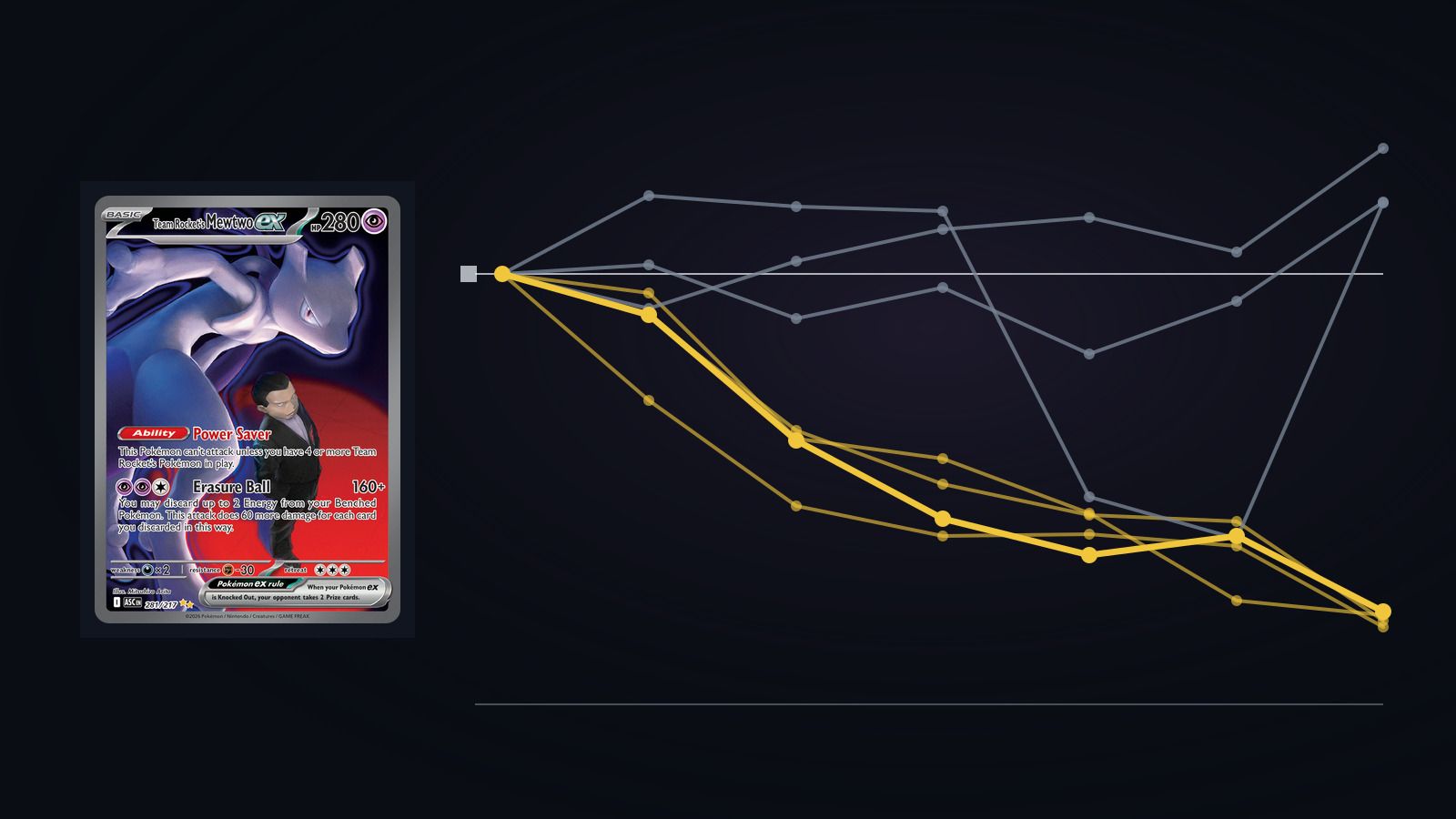
I pulled the same dated series for six more cards and indexed every one of them to 100 in April. The three other Ascended Heroes cards on our board end November at 17.9, 19.5 and 20.6 against this card's 21.6, a four point range that rules out any explanation belonging to Mewtwo alone. The lowest of those three is the Mega Gengar ex 284 whose census this section counted in September. Then I pulled three Base Set cards over exactly the same seven months, and they end at 116.3, 116.6 and 129.2.
One cohort kept a fifth of its gap and the other kept all of it and rather more. Charizard is the Base Set card I lean on least, and I'll say why rather than quietly dropping it from the picture. Its own monthly series reads $30,100 of gap in July, $11,306.25 in August, $8,984.01 in September and $27,248.49 now. That is a swing no market makes, and it is a thin trading artefact on a card whose tens sell a few times a quarter.
Blastoise and Venusaur move smoothly across all seven points and carry the finding without help. The honest version of the claim is that two Base Set cards plainly held their gap and a third probably did. That is still a cohort pointing one way while four cards from a 2026 set point the other, and none of the seven was chosen after I knew where it would land. I picked the Ascended Heroes cards because they share a set with the subject and the Base Set cards because they are the oldest rows our board ranks.
Our board ranks its 150 rows by the distance between a nine and a ten, multiplied by how often a ten turns up, then discounted by the card's age at a half every five years. That age term does a real job, which is pricing the fact that a cracked nine regrading ten is close to a modern card only event. Base Charizard gems at 0.5% on our census, so discounting it almost to nothing is correct arithmetic. The trouble is that the same single term is the only clock the ranking has, so it applies a 10% haircut to the cohort whose gaps fell 78% and a 98% haircut to the cohort whose gaps rose 17%. Nothing in the score asks how fast the quantity being ranked is disappearing.
There's a small coincidence in that control which I enjoyed more than it deserves. Mitsuhiro Arita illustrated Base Set Charizard in 1999, and the dump and the card face both say he illustrated this Mewtwo in 2026. It changes nothing about the arithmetic, and it is the sort of detail that makes a chart easier to remember. The chart is the argument here and the coincidence is not.
What would have to be true before I cracked this one
I'd want the gap to stop falling before I bought five months of queue with it. One flat month would do, measured the way I measured it here, off the dated series rather than off a headline that is already a fifth wrong on one leg. I'd also want a live gem rate rather than a month old one, which means waiting until GemRate answers a request again. None of those conditions is a forecast, and I'm not going to pretend I can tell you when the Ascended Heroes fall stops, because the four traces I measured are still pointing down at the last reading I have.
The case against me is straightforward and it is worth stating plainly. This trade clears by a mile at today's prices, the sample behind the rate is enormous, and a holder who sends the card this week still books $101.39 a card if nothing else moves. Anyone who thinks the Ascended Heroes fall is finished rather than continuing is making a reasonable call on a card whose raw price has already dropped from $348.03 in February to $179.47 today. I don't think it is finished, and the board that disagrees with me is public and sortable, so check the row yourself rather than taking my reading of it.
None of this predicts where Team Rocket's Mewtwo ex 281 goes next and none of it is financial advice. I hold no copy of this card and I am not buying one to crack. Hold the slab and measure the gap again in early December.