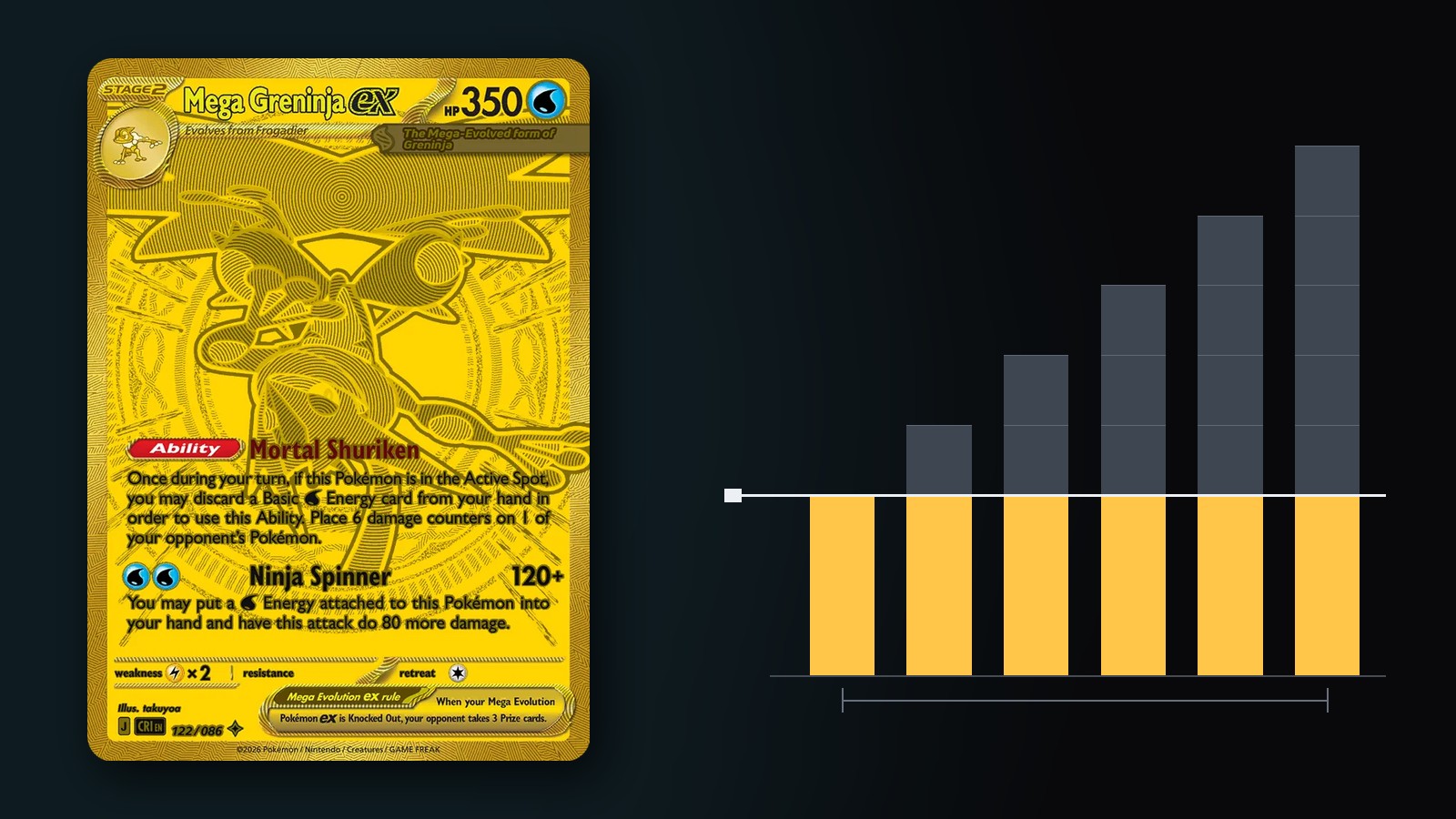
October 21, Mega Greninja ex 122, one nine, 184.40 dollars.
That figure is not what anybody is asking for the slab. It is what a PSA 9 Mega Greninja ex 122 puts in your hand after a marketplace takes its cut, plus the 59.99 dollars PSA wants for a second look. Cracking a PSA 9 Mega Greninja ex 122 clears the breakeven I build from today's prices and is still a hold, because one week of the gap closing costs more than the trade returns over twenty weeks of queue. A Glaceon ex 150 cleared its line back in September and I held that one too, so this is the second time the arithmetic and I have disagreed.
Five months of queue on a card printed five months ago
PSA's pricing page, read this morning, puts Standard at 59.99 dollars against a 1,000 dollar insured value, on an estimate of 90 to 100 business days. Priority costs 79.99 dollars and covers 1,500 on 70 to 80 business days, Express costs 199.00 and covers 2,500 on 20 to 30, and value services are still paused. Nothing on that table has moved since I read it on October 14, which makes five quiet weeks in a row after two reads that both changed it. A ten of this card sells well under the Standard cap, so the whole attempt is one 59.99 dollar line.
Chaos Rising reached shelves on May 22, which is five months ago almost to the day, and the card in question is number 122 in a set whose printed count stops at 86. Mail it today at Standard and PSA's own estimate hands it back around the middle of March. That second five months is the part of this trade almost nobody prices, and on this card it turns out to be the entire argument. Everything below is the arithmetic of a card you can sell this afternoon, measured against a card you get back in the spring.
The last seven tens sold at a median of 649.99 dollars
PriceCharting's completed sales for this card, read this morning, hold 30 results filed under PSA 10 running from August 31 to October 21. One of those is a 210.50 dollar sale whose own title calls it a PSA 10 candidate, meaning a raw card somebody hoped would grade, so I have thrown it out and worked from the 29 that remain. The ten oldest carry a median of 792.50 dollars and the ten newest carry 683.00, a fall of 109.50 inside about five weeks. Narrow it to the seven that have closed since October 14 and the median is 649.99, which sits a long way under the 585.72 dollar headline our tracker is carrying.
The nine has been sliding on the same clock, which changes the shape of this less than it sounds. Thirty graded nines sold between October 3 and October 21, and the ten oldest of those carry a median of 161.25 dollars against 143.00 for the ten newest. Both windows hold ten sales apiece, so neither median is one odd result. A falling nine sounds like good news for somebody cracking one, and the next section is where that stops being true.
A PSA 9 Mega Greninja ex 122 needs 14.55 percent to clear
Selling either grade costs about 13 percent between the marketplace cut and posting a slab, which is the assumption our board runs on. A ten at the realised 649.99 therefore leaves 565.49 dollars and a nine at 143.00 leaves 124.41. If you already own the slab, what you are really spending is the 124.41 sale you have decided not to make plus the 59.99 fee, so 184.40 dollars is the number the attempt has to beat.
A miss does not always come back a nine on this print, and that matters here. The stored census holds 2,050 grades of which 376 came back an eight, and PriceCharting puts a graded eight at 123.18 dollars, under what the raw card fetches. Weight each grade band by how often it actually appears and the average miss returns 119.53 dollars rather than 124.41. I spent a whole piece on that branch two weeks ago, on another gold print whose eights killed the trade outright, so here is the short version: it moves the line from 13.60 percent up to 14.55.
GemRate's trailing figure for this card is 18 percent, measured across 1,086 new grades in the last 30 days. The weekly series behind it adds 885 grades over its last four points, which brackets the same window from a different direction and tells me the sample is genuine rather than a rounding artefact. Lifetime across every copy ever submitted is 24.5 percent off 2,050 grades, so the recent month reads well under the card's own history, which is the usual shape once the cleanest copies have gone in. At 18 percent the holder clears and makes 15.41 dollars a card.
Half of this card's population arrived in the last month
Those 1,086 grades are worth staring at for a second, because the card has only 2,050 grades in total. More than half of everything PSA has ever slabbed of this card arrived inside the last 30 days, which is what a 2026 release looks like while its population is still being built. At 18 percent those 1,086 submissions produced roughly 195 new tens, set against the 503 that were already standing.
Hold that pace flat across the 90 to 100 business days PSA is quoting, call it four and four fifths calendar months, and the queue adds somewhere near 931 more tens. The population of tens would go from 503 to about 1,400, which is nearly three times what it is this morning and a different market from the one every price above was read in. I am not going to pretend that projection is precise, because submission pace is the one thing on this page I cannot measure forward. What I can say is that the 649.99 dollars I just used was paid in a market holding 503 tens, and the card you mail today comes back into a different one.
One week of decay against twenty weeks of queue
This is the part that settles it. The distance between a ten and a nine was 631.25 dollars at the older pair of medians and 540.00 at the newer pair. That is a loss of 91.25 across about five and a half weeks, which works out at 16.81 dollars a week. Priced at the realised ten, the whole trade returns 15.41 dollars a card. One week of the gap closing is therefore worth more than the entire trade, and PSA is quoting twenty weeks.
A buyer coming to this fresh has it worse again, and the difference between the two is not small. Someone going out with cash to buy a nine at 143.00 and crack it is spending 202.99 dollars, needs 18.71 percent, and loses 3.18 a card at the rate the month actually read. That is the same split I drew on a Groudon 199 last week, where owning the slab and buying one came out four points apart. The holder and the buyer disagree about whether this clears, which should tell you how thin the edge is, and a trade that turns on which of the two you are is not much of a trade.
Where I would be wrong about this
The sample is large enough to put a real band around that 18 percent, and the band is 15.72 to 20.28. A holder's line of 14.55 sits below the whole of that band, so the holder's edge is real and I am not going to argue it away on a sample of this size. A buyer's line of 18.71 sits inside it, which means the buyer case cannot be told apart from breakeven even on 1,086 grades. Two things would change my answer, and both are measurable rather than matters of taste.
The first is the gap itself, which is the only figure here that could turn this back into a trade. If the ten and the nine stop separating for six or eight weeks, the 16.81 dollars a week goes away and a 15.41 dollar return stops being erased before it is earned. The second is the submission pace, which you can watch on our PSA 9 board as the stored census refreshes. If those 1,086 grades a month drop to a few hundred, the supply of tens stops tripling while your card is in a box in California.
For what it is worth, PriceCharting has the loose card at 135.75 dollars this morning against 143.00 for the graded nine, so the slab carries about 7 dollars of premium over the raw copy. That premium is small enough that the nine is close to being a raw card with a number on it, which is the honest reason this row reached my screen at all. TCGplayer has the loose card at 115.58 the same morning, close enough to the other read that I am confident both pages are describing the same print. None of this predicts where the card goes next and none of it is financial advice. Hold the slab and check the gap again in late November.