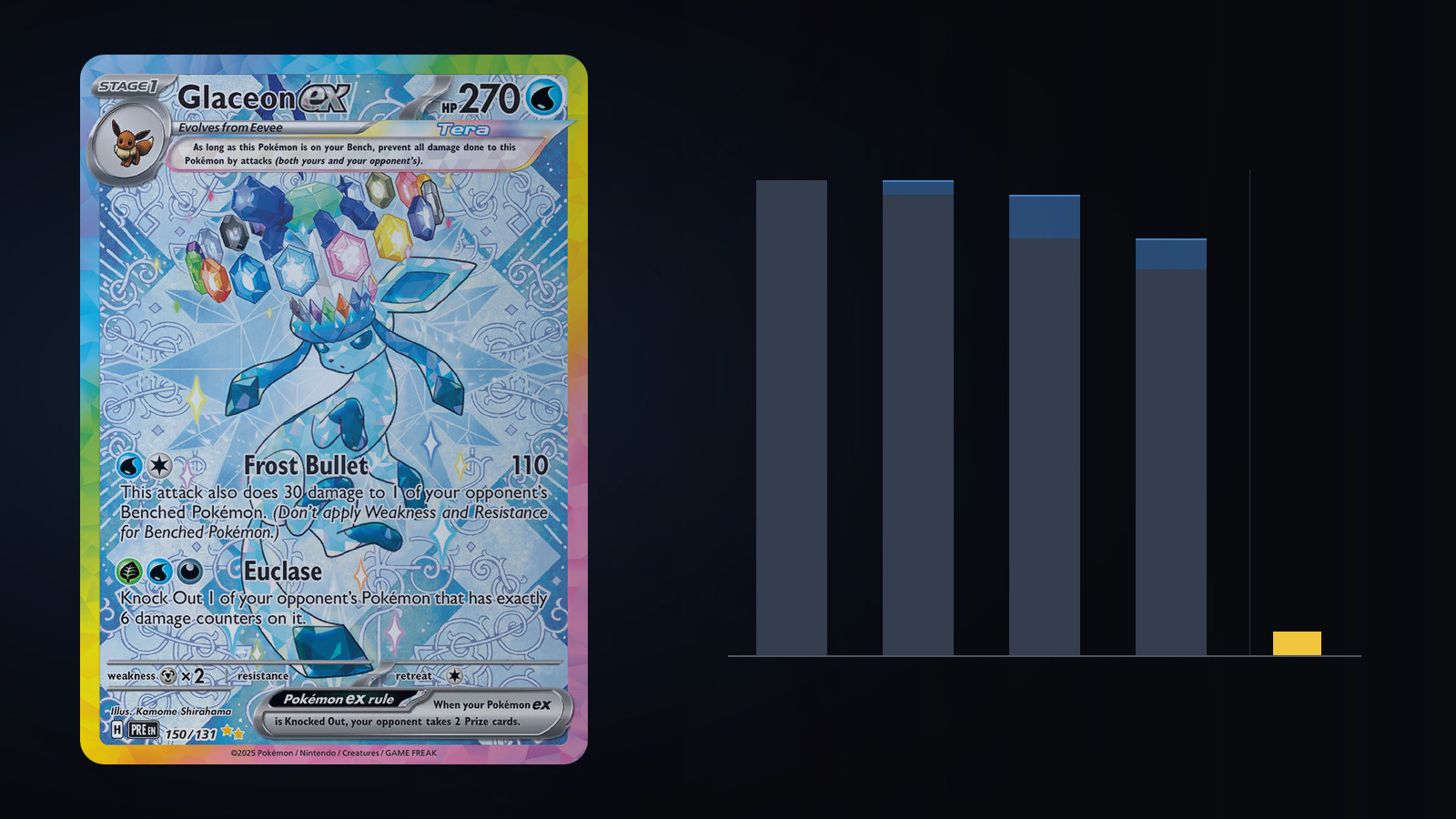
September 23, 2026, Glaceon ex 150, 294.65 dollars all in.
That total is a PSA 9 at the price PriceCharting carried this morning plus PSA's Standard tier, which is the cheapest door open on this particular card. Cracking a PSA 9 Glaceon ex 150 clears its breakeven gem rate and is still a hold, because the gap it's chasing loses more in an average month than the whole trade returns. The default answer in this column is hold, and this week it's hold for a new reason. A Glaceon ex 150 PSA 10 carries 685.50 dollars on that same page and the nine underneath it carries 234.66, and the distance between those two numbers is the only thing anybody is buying.
Two tiers are open on this card, and they sit five weeks apart
PSA's pricing page, read this morning, lists Standard at 59.99 dollars, caps declared value at 1,000, and estimates 90 to 100 business days. Priority sits above it at 79.99 dollars, caps declared value at 1,500, and estimates 70 to 80 business days. Value services are still paused, so those two are the whole of the choice for a card in this band. The cap decides more than it looks like it should, because a PSA 10 of this card runs comfortably under a thousand dollars, and that's the only reason the cheap tier is available to you here.
Ninety to a hundred business days is somewhere near five calendar months once weekends come out of it, and seventy to eighty is closer to three and a half. The two tiers are twenty dollars apart on the invoice and roughly five weeks apart on the calendar. Taking the nine at its live price, you're all in at 294.65 dollars on Standard and 314.65 on Priority. Neither number includes the postage, and I'll come back to that.
A ten pays 685.50 dollars and a miss pays 234.66
Sell the ten and the marketplace takes thirteen percent between its fee and the shipping, which is what our own board assumes. A ten therefore leaves 596.39 dollars in your hand once that thirteen percent is gone. A returned nine, sold the same way, leaves 204.15, which is 90.50 less than you paid to try on the cheap tier. So a hit pays about three hundred dollars and a miss costs about ninety, and that is a far kinder shape than most of what this column looks at.
Weight those two outcomes by a 30 percent chance of the ten and you get 321.83 dollars back on average. Against 294.65 that's a return of 27.18 a card on Standard, and against 314.65 it's 7.18 on Priority. Both of those numbers are above zero, and that has not happened once in the four cards this column has run before this one. Twenty seven dollars on a three hundred dollar outlay is nine percent, held for about five months with no way to take the money back early, and that one figure is the entire case for cracking this card.
The Glaceon ex 150 PSA 10 gap needs 23 percent, and the month delivered 30
The distance between the two grades is 450.84 dollars. Breakeven is the share of attempts that have to come back tens before that gap covers the fee and the selling cost, and it works out at 23 percent on Standard and 28 percent on Priority. The trailing 30 day gem rate on this card is 30 percent, measured by GemRate across the 357 grades it added in the month to September 19. That rate sits above both breakevens, which is why the answer above came out positive rather than negative.
The sample behind that rate checks out against a second count. Our source's own weekly tally shows 355 more graded copies than it did four weeks earlier, against the 357 it reports for the window, so the two agree. Lifetime on this card is 32.3 percent, because 3,686 of the 11,429 copies ever submitted came back tens, which is a much bigger denominator and a far longer stretch of submitting behavior. For once the lifetime figure and the trailing one point the same way, instead of lifetime flattering a trade the recent month would refuse. A 30 percent rate off 357 grades still carries a band of roughly five points either side, so the Priority breakeven sits inside that error and the Standard one sits clear of it.
Submissions into this card are also falling, which is worth knowing even though it moves nothing in the arithmetic. The month to September 19 added 357 grades where the month before it added 464, a drop of 23 percent in how fast people are sending this card in. That doesn't change the rate, and it does tell you the wave that built this population is past its peak. Every PSA 9 we can price against its own PSA 10 sits on one board, and this card is nowhere near the top of it.
The gap has been closing since June
Here is where it stops working. PriceCharting's monthly series puts the PSA 10 at 834.50 dollars in June, 812.50 in July, 730.00 in August and 685.50 today, against a high for the year of 836.84 back in April. The nine fell alongside it, from 280.00 in June to 234.66 now, but it fell by less, so the distance between them narrowed the whole way down. That gap read 554.50 dollars in June, 537.50 in July, 486.96 in August and 450.84 today.
Read those four numbers again with the trade in mind, because the shape they make is the whole of the argument against it. The thing you're buying lost 103.66 dollars of its size in three months. The month from July to August took 50.54 off the gap on its own, the month from August to September took another 36.12, and the trade's entire return on a successful attempt is 27.18. Only the June to July step, at 17.00, came in under what the trade pays.
34.55 dollars a month against a 27.18 dollar return
Averaged over those three months the gap has been shrinking by 34.55 dollars a month, and I'm giving that as a plain average of three steps rather than a forecast. If the next five months look anything like the last three, the gap is under 300 dollars by the time the slab comes home, and the breakeven rate that 30 percent currently clears has climbed past it. That is a conditional and I'd rather write it as one than pretend I know where this card trades in February. The queue is not a waiting cost on this trade, it is the trade's main risk.
This is the part a breakeven line is structurally unable to see. The line takes today's two prices, asks what share of tens covers the fee, and hands back a threshold. It has no opinion about whether those two prices survive five months, and on a card eighteen percent off its April high that silence does real work. The week PSA's cheapest tier dragged one breakeven down by nineteen points moved the same threshold a long way without the card moving at all.
What the breakeven line does not price
Two more things sit outside the formula and both of them cut the same way. The first is postage, which every piece of grading arithmetic I read online quietly leaves out. Getting a card to PSA and back, insured both directions, is not free at any carrier I've used, and every dollar of that comes straight out of the 27.18 rather than out of some separate budget. One round trip is a meaningful share of the entire return on a single card.
The second is the floor under a miss, and on this card that floor has a hole in it. The breakeven arithmetic assumes every card that isn't a ten is a nine you resell at the nine price, and the census says otherwise. The census puts 1,379 copies at an eight and another 297 at seven or below. That is about one in seven of everything graded on this card landing under a nine. An eight on this card sells for 207.50, which leaves 180.53 after the marketplace, and that is 114.12 below what you paid on the cheap tier.
Those eights are a population of raw submissions rather than resubmitted nines, so they overstate how often a slabbed nine falls. They do not overstate it to zero, and the formula prices that branch at exactly nothing. A card where the same arithmetic came out thirty two cents short was an easy week to write, because a negative number argues for itself. A positive one this small is harder, and that is the reason this column exists.
The version of this trade I would actually mail
I'd want the gap flat or widening across two consecutive monthly reads before I sent this card anywhere, and I'd want the trailing rate holding above 30 percent while that happened. Neither of those is true today, so the 27.18 is a figure I can compute and not one I can collect. If you already hold the nine, the cost of doing nothing is zero, and doing nothing is what I'm doing with mine. Leave it slabbed until the gap holds still for two months.