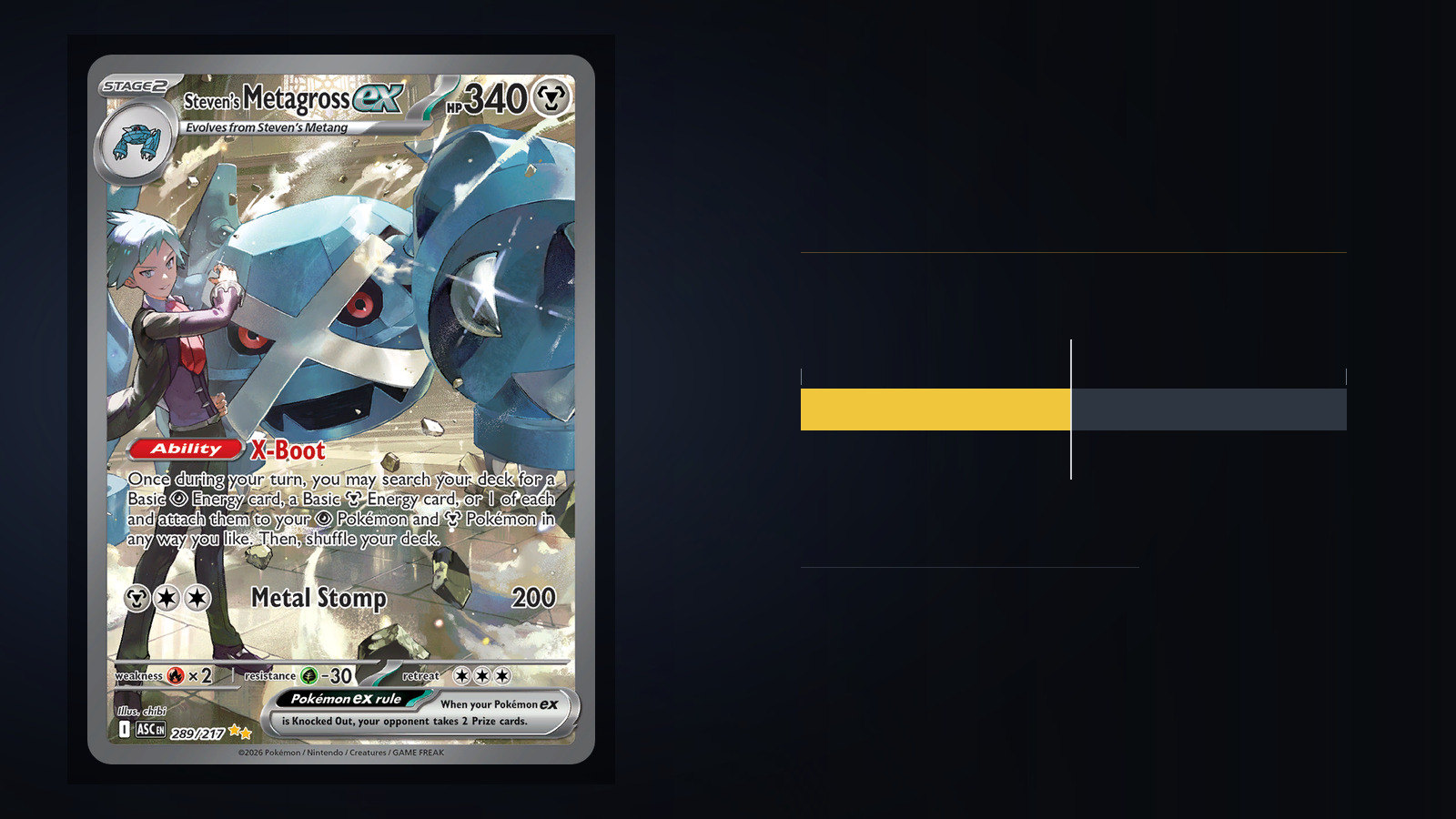
September 9, 2026, Metagross ex 289, 159.13 dollars all in.
That's a PSA 9 at its own market price plus the cheapest tier PSA is selling today. Cracking a PSA 9 Steven's Metagross ex 289 loses money at a 64 percent gem rate, because the fee alone takes half the gap between the two grades. The default answer in this column is hold, and today it's hold. It holds by about thirty cents a card, which is close enough to zero that I want you to see every leg of the arithmetic rather than the verdict, including the one reading where the trade turns a profit.
What 159.13 dollars buys before a grader looks
PSA still isn't taking Value submissions, so Regular at 79.99 dollars a card is the cheapest door open to me this morning. That tier insures a card to 1,500 dollars and quotes 70 to 80 business days, which is roughly four months between the post office and the return box. The nine you'd be cracking costs 79.14 dollars on PriceCharting's live page this morning. Twenty six PSA 9 copies sold between August 9 and September 5 on the completed auction tape that page keeps, and their median is 78.50 dollars, so the headline and the realised market agree within about sixty cents. Postage both ways and insurance sit on top of all of it, and no price guide anywhere carries that line.
What the ten pays, and what the nine gives back
A PSA 10 reads 240.71 dollars on that same page, and the realised tape backs it almost exactly. Thirty PSA 10 sales since August 24 carry a median of 240.70 dollars, a low of 217.50 dollars and a high of 385.46 dollars. Sell that ten and 13 percent goes to the marketplace and the shipping, so a hit leaves 209.42 dollars in hand against an outlay of 159.13 dollars and clears about fifty. The miss is where this card is unusual, because a nine resells at 68.85 dollars after the same 13 percent, and that's ten dollars under the raw copy you could have bought on TCGplayer for 78.31 dollars.
So the trade turns on one number, the share of resubmissions that come back tens, and four readings of the two price legs put the rate it needs between 63.9 and 64.2 percent. Each line below pairs a nine price with a ten price from one source, because a raw price off one site and a graded price off another can describe two different products. None of the four moves the answer, which is the only reason I'd publish a margin this thin.
- Our own board, read today, pairs 79.14 dollars with 240.71 dollars and needs 64.2 percent.
- PriceCharting's live page, opened this morning, is where those two figures come from in the first place, so it lands on the same 64.2 percent.
- The realised tape since August 9, 26 sales of the nine and 30 of the ten, pairs 78.50 dollars with 240.70 dollars and needs 63.9 percent.
- Crossing the two sources either way needs 63.9 or 64.2 percent.
A PSA 9 Steven's Metagross ex 289 needs 64.2 percent
The trailing 30 day gem rate on this card is 64 percent, measured across the 943 grades it added in the month to September 7. Breakeven sits at 64.2 percent on our own board, which rounds to 64 percent on the tile, so the trade returns minus thirty two cents a card. Run it against the realised tape instead and the same arithmetic returns plus twelve cents, which is the honest range this week, two readings of one card landing thirty cents apart on either side of nothing. A rate of 64 percent off 943 grades carries a 95 percent band of 60.9 to 67.1 percent, so every breakeven in that list sits inside the error, and a bigger month wouldn't sharpen it. You can't tell this trade apart from a coin toss on today's numbers.
Lifetime on this card is 63.4 percent, because 2,047 of the 3,228 copies ever submitted came back tens, and this is the rare week where lifetime and trailing agree. On most cards this column looks at, the lifetime figure is the trap, running ten or fifteen points above the month that actually just happened. That's what killed it when we ran the same arithmetic on a Charizard ex 199 last week, where the lifetime figure read twice the trailing one and the trade still failed. Here the two sit within a point of each other, so no version of the gem rate rescues this, and whatever is killing it has to be somewhere else. Submissions are falling too, down 8 percent against the 1,026 grades of the month before.
Where the fee goes, which is half the gap
The distance between a nine and a ten on this card is 161.57 dollars, and PSA's fee is 79.99 of it. That's 49.5 percent of it, gone before a grader has opened the envelope. The marketplace then takes 13 percent of whatever comes back, so a 64 percent hit rate is spending half the prize to enter, a slice of the rest to leave, and four months of waiting in between. Sixty four percent is a good gem rate, and it still cannot pay a flat fee against a gap this narrow.
The tier list makes the point harder than I can, because at Express, 149 dollars a card, breakeven climbs to 113.3 percent, which is a rate that cannot exist. No run of luck clears a fee larger than the gap you're chasing. Regular is the only tier this card can even be argued at, and Regular is the one that locks it away until roughly January. Four months is real money on a set that only reached shelves in January of 2026, and I've no way to tell you which direction that goes. The page explaining how that breakeven figure is built shows the same fee under every card we price.
What would have to change before I mailed it
A trailing rate near 70 percent clears about five percent on the outlay, and 75.5 percent clears ten. Ten percent is the first number in this piece I'd think was worth four months in a queue. The other route is a PSA 10 at 241.28 dollars, and it trades at 240.71 dollars, so the ten is fifty seven cents short of paying for the attempt.
I checked this one twice for that reason, because a trade landing this close usually means a price leg is wrong rather than a market being efficient. It isn't wrong here, since the raw card reads 84.53 dollars on PriceCharting, 84 dollars across 41 realised sales and 78.31 dollars on TCGplayer, which is three sources inside seven percent of each other. The board where we line up every nine and ten price we track is where I go looking for the version of this with room in it. Our read on the Mega Gengar census out of this same set is the same habit pointed at a population instead of a fee. Skip this one and check the gap before the gem rate.