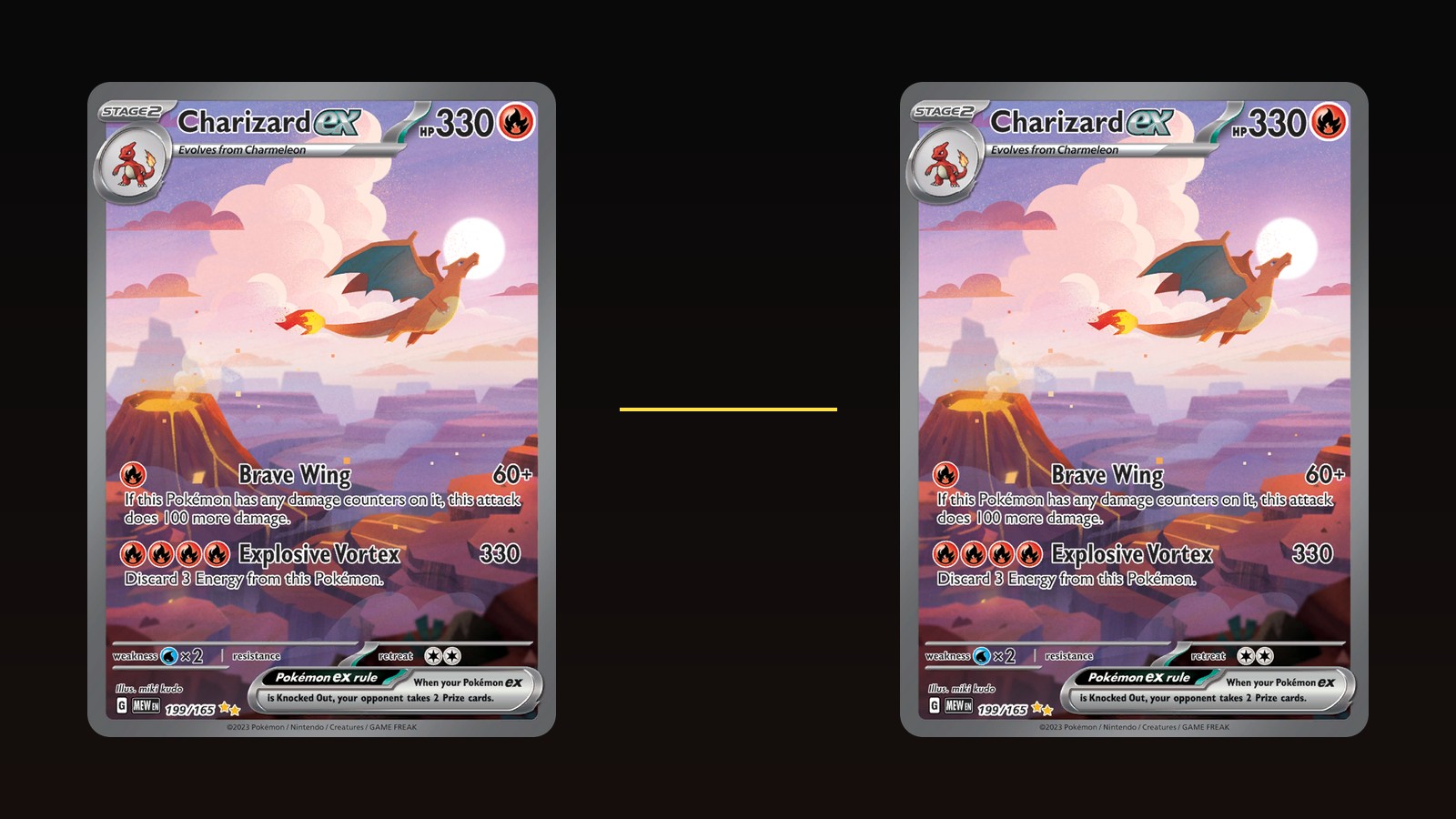
September 2, 2026, Charizard ex 199, 79.99 dollars at Regular.
That is the cheapest tier PSA is taking today, with the Value services still paused, and the card then sits in a queue for 70 to 80 business days. Cracking a PSA 9 Charizard ex 199 loses money at the trailing gem rate and makes money only at the lifetime one, which is why this column reads the trailing figure first. The default answer here is hold, and today it holds by four tenths of a point rather than by any comfortable margin. You get every line of the arithmetic below, including the two readings that argue for cracking it.
The bill before a grader sees it
The nine is the expensive part on this card, which makes it an odd one for this column. 26 PSA 9 copies sold between August 2 and September 2 on the completed auction tape PriceCharting keeps, and the median of them is 395 dollars. Add the fee and you are 474.99 dollars into a card before it ships, against an ungraded copy whose own tape has a median of 351.50 dollars since August 2. Postage both ways and insurance sit on top of every one of those figures. Every submitter pays them, and no price guide anywhere carries that cost.
What a ten returns on a card this heavily graded
PriceCharting's product page read 1,410 dollars in a PSA 10 when I opened it this morning, with the Grade 9 line at 402.50 dollars and ungraded at 366.81 dollars. The realised side of the market agrees with that headline figure almost exactly. 30 PSA 10 sales since August 2 carry a median of 1,410 dollars, a low of 1,349.99 dollars and a high of 2,299 dollars. Sell that ten today and 13 percent goes to the marketplace and the shipping, which leaves 1,226.70 dollars in hand against 474.99 dollars spent, so a hit clears 751.71 dollars. A miss is the softer half of this trade, since the nine resells at 343.65 dollars after the same 13 percent, which leaves the attempt down 131.34 dollars.
So the trade turns on one quantity, the share of resubmissions that come home as tens. Four independent readings of the two price legs put the rate it needs between 14.4 and 15.1 percent today. Each line below pairs a nine price with a ten price from the same source, because mixing a raw price off one site with a graded price off another can quietly describe two different products.
- Our own board, read on September 2, pairs 395 dollars with 1,442.50 dollars and needs 14.4 percent.
- PriceCharting's live page, opened today, pairs 402.50 dollars with 1,410 dollars and needs 15.1 percent.
- The realised tape since August 2, 26 sales of the nine and 30 of the ten, pairs 395 dollars with 1,410 dollars and needs 14.9 percent.
- The tracker's other row for the same card, read today, pairs 390 dollars with 1,410 dollars and needs 14.7 percent.
Cracking a PSA 9 Charizard ex 199 turns on 14 percent
The trailing 30 day gem rate on this card is 14 percent, measured across the 1,514 grades it added in the month to August 28. Breakeven sits above that on every reading, though our own board rounds its 14.4 percent down to 15 percent on the tile. So the trade returns minus 7.71 dollars a card against the realised tape and minus 9.60 dollars against the live page. Those are small losses today on a 474.99 dollar outlay, and still losses. A rate of 14 percent off 1,514 grades carries a 95 percent band of 12.3 to 15.7 percent, so every breakeven in that list falls inside the error and the trade cannot be told apart from a coin toss.
Where the lifetime rate sends you the wrong way
Lifetime on this card is 27.5 percent, because 28,477 of the 103,611 copies ever submitted came back tens. Run the same arithmetic at that rate and the trade turns from a 7.71 dollar loss into a 111.50 dollar gain a card. The two figures describe different populations, one being every copy sent in since September of 2023 and the other only the copies graded last month. Early submissions on a fresh set are pack fresh cards picked by hand, and what reaches PSA three years later has been through several owners and a few binders.
I did not take that 14 percent on trust from one file. An older copy of the same census, last read on August 13, counted 102,881 grades and 28,379 tens. The current one at August 28 counts 103,611 and 28,477, so 98 of the 730 grades added in that fortnight came back tens, which is 13.4 percent. Two dated snapshots a fortnight apart landed on the trailing figure, nowhere near the lifetime one. We ran the same arithmetic on a much cheaper slab in the Deoxys VSTAR resubmission we priced in August, where the nine cost a tenth of this one.
The two lines that argue for cracking it
The ten itself is not sliding, which is the thing I expected to find. 8 sales before August 24 carried a median of 1,417.50 dollars and the 22 since carried 1,410 dollars, so four months in a queue is not visibly costing you at the moment. The miss is also cheap in relative terms, since the nine gives back 343.65 dollars of the 474.99 dollars you put in, so a wrong guess costs 28 percent of the outlay rather than the card. That is the version of this trade I would take at a better rate, and the board that keeps a nine price beside a ten price on every card we track is where I go looking for it.
What would move me is a trailing rate near 18 percent, which clears about 28 dollars a card at today's prices and would take a real change in what people are sending in. The other route is a PSA 10 near 1,770 dollars, which would drop breakeven to 11 percent and leave the gem rate room to be wrong by a few points. Neither is close today, and the page setting out how the breakeven figure is built shows why. Our read on the Mega Gengar census the room never opened is the same habit in a different column, trusting a headline rate without asking which month made it. Hold the nine, and buy the ten on the tape instead.