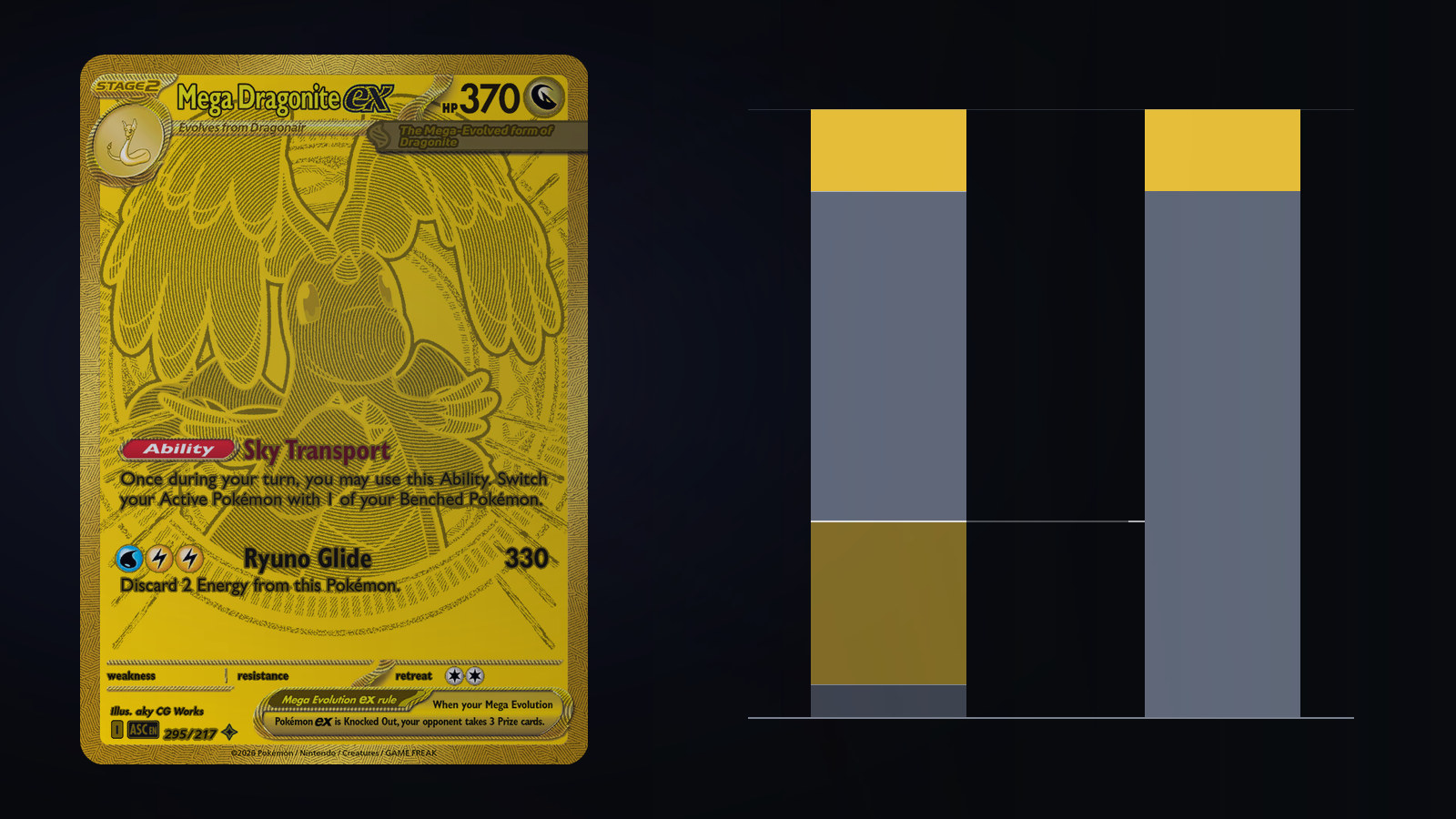
October 7, 2026, Mega Dragonite ex 295, one nine, 282.49.
That number is a PSA 9 at the price our own PSA 9 board carried this morning, plus a grading fee the card's own ceiling picks for it. Cracking a PSA 9 Mega Dragonite ex 295 loses money once a returned eight is priced, because the board treats every miss as a nine and this gold print returns an eight more than a quarter of the time. The default answer in this column is hold, and this week the whole argument for it sits in a branch our own arithmetic does not have. That board rounds the row's breakeven to 15 percent and the card's trailing gem rate is also 15, which is how little room there is before anything else gets counted.
The fee is 79.99 dollars because a ten is worth 1,029.34
PSA's pricing page, read this morning, puts Standard at 59.99 dollars against a thousand dollar insured value, on an estimate of 90 to 100 business days. Priority costs 79.99 and covers 1,500 on 70 to 80 business days, while Express costs 199.00 and covers 2,500 on 20 to 30. Value services are still paused, and nothing else on that table has moved since I last read it on September 30, which makes three quiet weeks after two reads that both changed it. A ten of this card carries 1,029.34 dollars, which sits 29.34 over the Standard cap.
I wrote the long version of that constraint last week, on a Seismitoad whose ten forced it all the way into Express, so I'll keep it short. PSA's terms tell you to pick a service level whose maximum insured value exceeds your own estimate of what the card is worth after grading. Missing the cheap door by 29.34 dollars is a detail rather than the story, and the story is further down. Add the nine at 202.50 dollars to the 79.99 fee and you're out 282.49 before postage in either direction, with a slab destroyed to get there.
A ten pays 895.53 dollars back and a nine pays 176.18
Sell the ten and the marketplace takes thirteen percent between its cut and the cost of posting a slab, which is the assumption the board runs on. A ten at 1,029.34 dollars therefore leaves 895.53 in your hand. A returned nine sold the same way leaves 176.18, which is 106.31 less than you paid to try, so a hit clears about 613 dollars while a miss costs about 106. That shape is what puts the row high on the board, and it is also what gets slabs cracked early.
Weight those two outcomes at the trailing rate and the average payout comes to 284.08 dollars against 282.49 paid, so the trade clears by 1.59 a card. I want to be careful about how small that is, because 1.59 dollars on a 282.49 dollar cycle returns about half of one percent. Four months of queue buys you that, and the figure gets worse rather than better from here.
The trailing rate is 15 percent and the line sits at 14.8
GemRate's published trailing figure for this card is 15 percent, measured over a window that closed on October 1 and covered 862 new grades. Lifetime across every copy ever submitted is 18.1 percent off 4,425 grades, so the recent month runs a little under the card's own history. Breakeven at the 79.99 fee works out at 14.78 percent before the board rounds it to 15, which leaves two tenths of a point between the rate and the line. Two tenths of a point is worth 1.59 dollars here, because one whole point on this row is worth 7.19.
Eight hundred and sixty two grades is a real sample rather than a handful, and it puts a 95 percent interval of roughly 12.6 to 17.4 percent around that 15. In dollars that interval runs from a loss of 15.56 a card to a gain of 18.74. Either edge of that interval sits about eleven times further from zero than the return does. I ran my own count rather than taking the published rate on trust. The two dated copies of the census I hold put 65 new tens inside 483 new grades, which is 13.5 percent and sits below the line rather than above it.
What the board calls a miss, and what the census calls one
Here is the branch the arithmetic above does not have. Both of those readings assume a miss comes back a nine and sells for the nine price, and on this card that assumption is doing enormous work. The two dated census copies are September 16 and October 1, and the 483 grades returned between them hold 65 tens against 262 nines. Underneath those sit 130 eights and 23 sevens, with three more copies below that. Better than a quarter of the cards that went in came back an eight, and the board prices none of them.
PriceCharting lists a grade eight of this card at 182.50 dollars against 202.50 for the nine, both read live this morning, so twenty dollars of difference sounds survivable right up until you put it beside the trade. Net of the thirteen percent, each eight instead of a nine costs 17.40. Work out how many eights it takes to erase a 1.59 dollar return and the answer is 9.1 percent of outcomes. The measured eight share on this card's most recent 483 grades is 26.9 percent.
Price all five branches at the shares the census actually returned and the average payout drops to 266.89 dollars against 282.49 paid, which is a loss of 15.60 a card rather than a gain of 1.59. I can't measure how often a cracked nine comes back an eight, and I'm not going to pretend otherwise, because nobody publishes a resubmission ladder I have ever seen worth citing. What I can do instead is put a bound around the question. The board's answer survives only if a cracked nine returns an eight less than one time in eleven, on a card whose raw submissions do it better than one time in four.
The gold print misses by a mechanism its siblings do not have
This is where the card gets a say, and the control is clean, because Mega Dragonite ex was printed four times in English inside one set. The plain Double Rare at 152 reaches an eight 2.74 percent of the time and the Mega Attack Rare at 271 does it 2.24 percent. Asking that same question of the Base Set 2 Blastoise reprint is why I trust an eight band as a measure of a print rather than of its owners. The Special Illustration Rare at 290 reaches an eight 3.30 percent of the time while gemming at 62.8 percent. The gold Mega Hyper Rare at 295, printed from the same sheets into the same packs and pulled by the same people, reaches one 21.4 percent of the time and gems at 18.1 percent.
Same Pokemon, same set, same packs, same graders, same submitters, and an eight band seven times the size. Widen it to the whole English set and the pattern holds across 84 rows. Pooled, the Special Illustration Rares return an eight 3.22 percent of the time across 109,625 grades, against 3.70 percent for the Illustration Rares across 93,049. The two gold Mega Hyper Rares return one 21.44 percent of the time across 11,761 grades. The other gold card in the set, a Mega Charizard Y, sits at 21.5 percent against this Dragonite's 21.4, which is what tells me I'm looking at a finish rather than at a card.
Why that happens is the part I would hedge rather than assert. A flat gold face probably shows the edge chipping and surface scuffing that a textured holo pattern hides, and these cards come out of the pack already carrying it rather than picking it up in a binder. That is me guessing at a cause rather than counting one. The 21.4 percent is counted, and it is the number the trade has to survive.
The ten is already selling under the figure this rests on
One more check, because every leg of this wants reading twice. PriceCharting's realised sold tape lists thirty PSA 10 sales of this card between August 1 and September 29, at a median of 1,152.50 dollars, against the 1,029.34 the board uses. Split those thirty by month and August medians 1,180.00 across sixteen sales while September medians 1,065.50 across fourteen. The four most recent sales on the tape are 1,009.00, 975.00, 950.00 and 945.00, every one of them under the price the breakeven above was computed from.
The nine leg holds up perfectly by comparison, which is the kind of agreement that tells me the two sources describe the same product. Thirty grade nine sales since August 31 median 202.50 dollars, matching the headline figure to the cent, and dropping the six titles in that list graded by somebody other than PSA moves it to 203.50. TCGplayer's market price for the raw card is 195.64 today against PriceCharting's 198.35 ungraded, 1.4 percent apart. That agreement is the check that once caught a Champion's Path Venusaur V carrying a stored price more than a hundred times the card's real one. Run the whole calculation on the second half of September instead, with the ten at 1,004.50, and breakeven moves out to 15.2 percent while the five branch answer falls to a loss of 18.50.
What gets this one an envelope
A ten would have to reach about 1,162.55 dollars for the five branch answer to get back to zero at today's fee. The tape says the ten is going the other way, and has been going that way since August. Raise the trailing gem rate instead and the five branch line sits at 15.6 percent, against a card that has posted 15 and 13.5 on its two most recent reads. Either of those would change my answer and I'd write the opposite piece without complaint.
I held a Glaceon ex 150 two weeks ago that cleared its breakeven on paper, and this is the same verdict reached down a completely different road. None of what is above predicts where this card goes next, and none of it is financial advice. The honest summary is that our own board reads this row as marginally positive and is wrong by about seventeen dollars a card, because it prices two outcomes on a print that returns five. I'd rather publish that than quietly leave the eight band out and let the row stand. Price the eight branch before you decide what the ten pays.