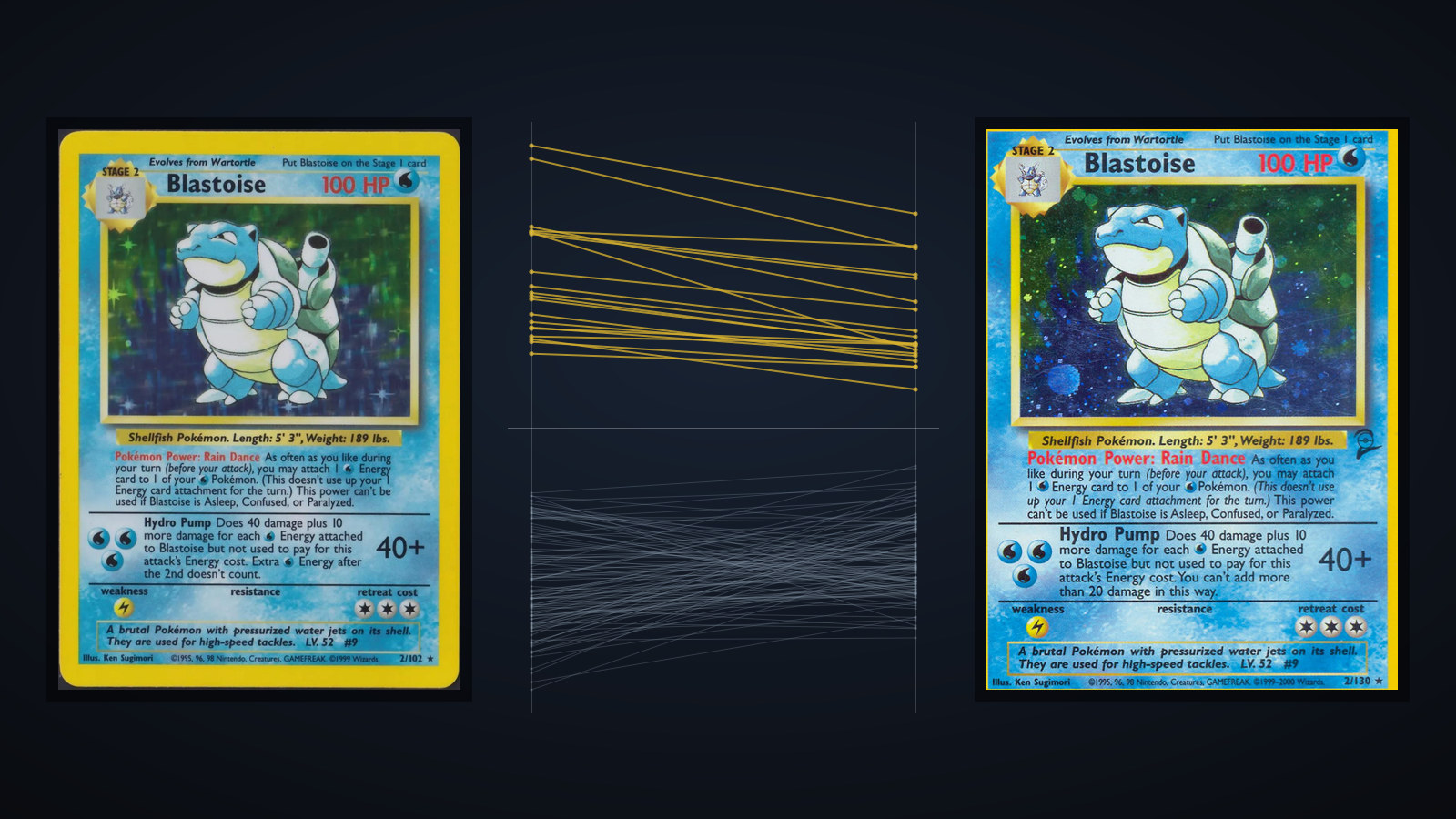
Blastoise 2 of 130, printed by Wizards of the Coast in the February 2000 reprint set called Base Set 2, carries a Cosmos foil that the 1999 original never wore. The Cosmos foil that arrived with the 2000 reprint is what caps the Base Set 2 Blastoise, and the plain cards printed alongside it are the evidence. Most of them grade better than their own 1999 originals, while every foiled pair grades worse once the beaten copies leave the count. I have handled enough stock from both prints over the years to expect the reprint to arrive in rougher condition than the card it copies, and it does not. The grading census says so twice over, once on the share of copies that reach a PSA 8 at all and once on what becomes of the copies that do. That pairing is unusually clean as evidence, because the same catalog of card art Ken Sugimori drew for the game supplied the illustration on both. The two sit inside the same yellow border and the same frame, with only the year of manufacture and the foil standing between them.
What Wizards of the Coast put on shelves in February of 2000
The set reached shops on February 24 of 2000, and the product page the publisher kept on its own website that spring gives the reason for it in a single paragraph. Wizards of the Coast described Base Set 2 there as a selection of cards from both the original Base Set and the Jungle expansion, released to mark the first anniversary of the game in English. I read that page and its checklist off an archived copy of wizards.com captured in April of 2000, rather than off any modern hobby write up. The checklist runs to 130 cards, of which exactly 20 carry the rarity line Rare Holo. Those 20 are the whole foiled half of the set, drawn from Base Set of January 1999 and from Jungle of June 1999. The same page prices an 11 card booster at 3.29 dollars and sells a two player starter set packed with an instructional CD-ROM at 14.99 dollars. That puts the release in the mass retail channel at the peak of the boom rather than in a hobby shop. No first edition run was ever made of it, and the population report bears that out, because every Base Set 2 card arrives there under a single printing where a Base Set card arrives under three.
A foil the 1999 press had never used
I put a scan of each Blastoise side by side at full resolution and looked only at the artwork window, since that is the one region of either card carrying any foil at all. On the 1999 card the foil breaks into long angular facets, with four pointed flares thrown out across the water behind the Pokemon. Collectors call that treatment shattered ice, and it is what sits under the Jungle Wigglytuff I pulled up as a second control. On the 2000 card the structure has gone, and the window instead holds a dense even field of small round speckles, which is the Cosmos foil that ran under most of what came afterwards. The two faces are otherwise the same printing job, down to the italic flavour text and the Length and Weight line above it. Two other marks separate them and both sit in the bottom margin, where the reprint reads 2 of 130 against the original's 2 of 102 and the copyright line runs from 1999 to 2000 where the original names 1999 alone. The account of why the foil changed, usually that the Cosmos sheets were cheaper to run, is hobby lore rather than record, and I have never found a printing document behind it. This piece therefore treats the foil as a difference I can see rather than as a decision I can source.
Twenty illustrations printed twice, and where each pair landed
Our tracker keeps a curated population table for the whole Wizards of the Coast era, and I sorted the reprinted rares against their originals one illustration at a time. There are 20 matched foiled pairs, and on the plain rate of tens per copy submitted the 2000 print loses 19 of them. Pooled across all 20, the reprint has produced 1,044 tens from 112,375 graded copies. That is a rate of 0.93 percent against 1.39 percent on 458,498 copies of the same illustrations printed a year earlier. Ninetales is the one card that beats its original outright, and it stops beating it the moment the beaten copies leave the arithmetic. Counting tens only among copies that reached a PSA 8 or better, which drops the ones returned creased or scuffed or cut badly enough to fall out of the top three grades, the 2000 print loses 20 pairs of 20. That second count is the one worth holding on to, for a reason the first count hides. The reprint reaches a PSA 8 or better more often than its own original on 11 of the 20 pairs, and pooled it reaches one on 38.08 percent of submissions against 37.15 percent.
The 110 cards in the same set that carry no foil
A reprint grading worse than its original has several plausible causes and most of them have nothing to do with a press. The 2000 cards were opened later, sat in different binders, passed through different hands, and reached a grader from people with later habits. The 110 unfoiled cards of Base Set 2 test every one of those causes at once. They shipped in the same packs off the same shelves to the same buyers, and they are the same illustrations reprinted from the same two 1999 sets. There are 110 of them matched to an original, and against those the 2000 print does not lose at all. It wins 82 pairs on the plain rate and 74 once the count is restricted to copies that reached a PSA 8, and pooled it makes tens on 22.84 percent of submissions against 19.97 percent for the 1999 cards. The reprint penalty is therefore not something that happened to Base Set 2 in the twenty six years since it left the shop, since that would have reached the unfoiled cards as well and they run the other way instead. Whatever it is, it belongs to the foiled sheet and to nothing the two halves of the set have in common.
Where the Base Set 2 Blastoise PSA 10 count stands
The subject card has 12,106 graded copies on the census this site reads and 61 of them are tens, a rate of 0.5 percent. The 1999 Unlimited print of the identical illustration has 52,075 graded copies and 380 tens, which is 0.7 percent. Set the two against each other on surviving copies alone and the gap widens rather than narrows. A share of 31.0 percent of submitted reprints reaches a PSA 8 or better against 29.8 percent of the originals, so the reprint arrives in marginally the better shape of the pair, and it still turns those copies into tens at 1.6 percent against 2.4 percent. Every part of the loss therefore sits above the PSA 8 line, in the band where centering and surface finish decide a grade and where a crease or a soft corner has already stopped mattering. That is a cut and finish signature rather than a wear signature, and it is the same division I ran on the Skyridge secret rare that changed rank once the beaten copies left its count. There the same conditioning rescued a card from the middle of its block rather than convicting one. Submissions have not stopped either, with 181 fresh grades added to the reprint in the trailing thirty days.
The part of this that a census cannot settle
Three things stand between the count above and a printing conclusion, and the honest version of this piece names all three. The first is who submits, since the 1999 Blastoise is the dearer card of the pair, which means marginal copies of it are worth mailing and marginal copies of the reprint are not, and that bias should flatter the 2000 print rather than sink it. The second is the sheet, which is not shared by the control at all. Holofoil rares were laid out and cut on their own foiled sheet in this era, so the unfoiled cards rule out the decade and the handling and the buyers without ruling out that the foiled sheet of 2000 was simply trimmed worse than the foiled sheet of 1999. Telling a foil that reads badly under a grader's lamp apart from a sheet that came off the trimmer off centre is not something a population table can do, and I am not going to pretend otherwise from six scans and a checklist. The third is price, which does not appear in this piece at all. The completed sale table I read on September 24 of 2026 held 19 PSA 10 rows stretching back to April of 2022, one of them a Celebrations Classic Collection card filed under the wrong product, and a quoted mark standing several times above the median of its own tape is not a figure worth printing. Every population number here is rebuilt on each refresh, and the notes setting out how this site assembles a card census give the provenance of each column in the table.
What two presses left on the copies that survive
What sits on the table in front of a grader today is two cards that agree on everything except the year and the light. The 1999 print throws long flares out of its artwork window when the card is tilted, and those flares gather scratches into legible lines running with the facets. The 2000 print scatters the same light into a fine even glitter. A scratch on it reads as a dull patch rather than as a line, which is harder to see and no easier to forgive. Both cards brown at the four corners of a yellow border before they fail anywhere else, and both hold a matt strip of that border on all four sides that keeps the record of every thumb. That last part they share with the first edition Lugia whose corners we measured against the rest of its own set, printed later the same year and graded on the same four points. Of the 12,106 reprints that have reached a grader 61 carry a ten, and of the 52,075 originals 380 do, and the survivors on both sides of that pair still show the sheet they were cut from before they show the hands they passed through.