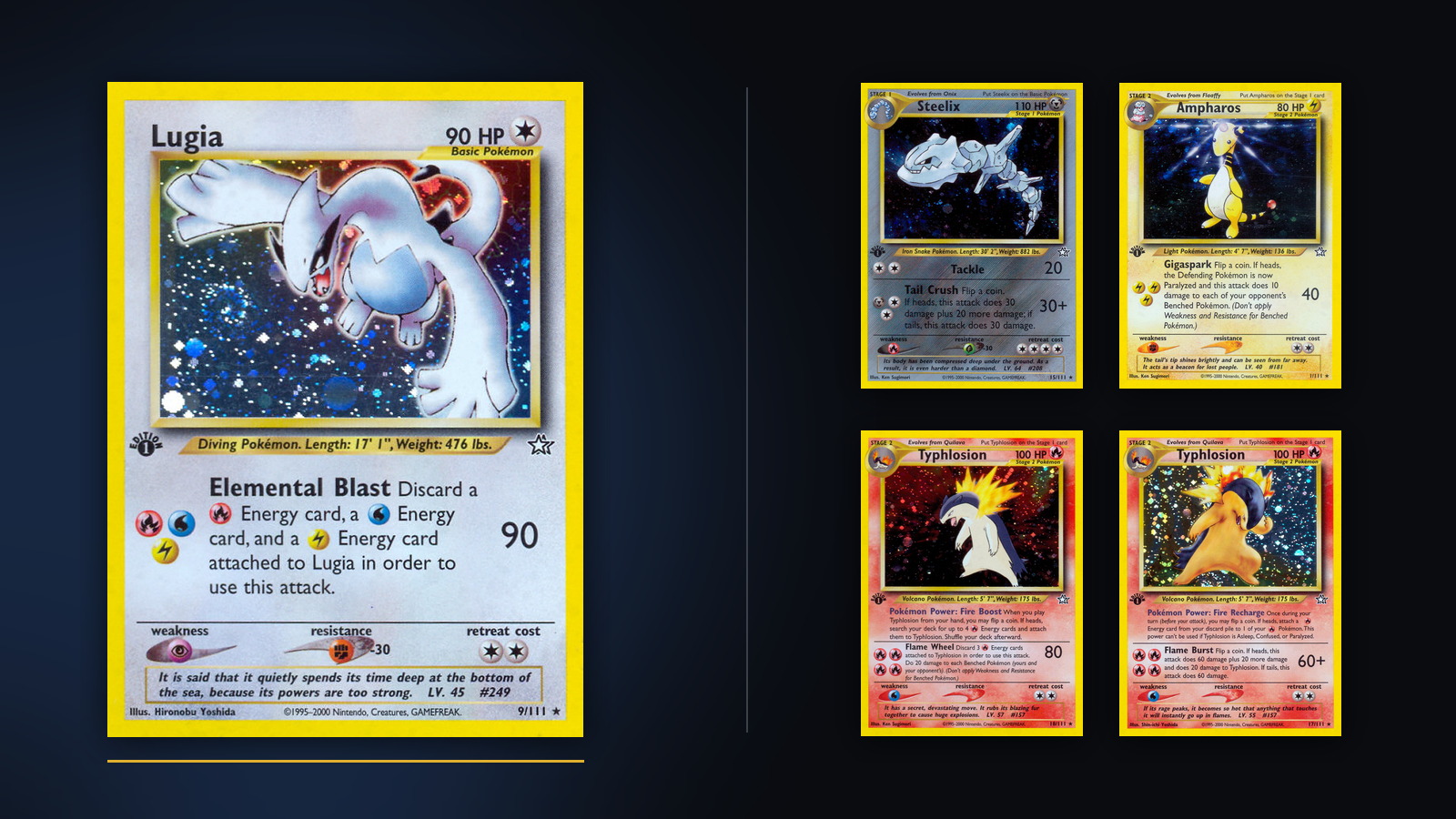
The English Neo Genesis Lugia, card 9 of 111, printed in December of 2000 in both a first edition run and an unlimited one, is graded on its corners rather than on its cut. The Neo Genesis Lugia is capped by the condition of the copies people chose to submit rather than by anything Wizards of the Coast did at the press, and the eighteen holofoil rares cut alongside it are the evidence for that. I pulled all nineteen holofoil rows for this set out of our tracker this morning in both printings, then read the release history and the current grading standard beside them. That leaves two prints of one card made the same way in the same year. What varies between them is only what happened after somebody opened the pack. It also leaves eighteen sibling cards that came out of the same packs on the same December afternoon and now sit an order of magnitude apart on the same scale. The Neo Genesis Lugia PSA 10 count is small enough to list by hand, and every figure below is dated.
The set that opened the Neo series
The release history I read this morning dates the English Neo Genesis to December 16 of 2000 and counts 111 cards in it. It was the first English expansion to carry Generation II Pokemon, and it introduced the Darkness and Metal types along with a redrawn card frame whose evolution box became a circle. The Japanese original had reached shelves ten months earlier, on February 4 of 2000, under a different name and with 96 cards rather than 111, so the English printing that collectors send to graders today was already a reissue of a set that had been a year old at home. That same history records the English set shipping in both first edition and unlimited printings, alongside four other European languages that did the same. What it does not carry anywhere, and what no Wizards of the Coast document has ever carried, is a print run for either printing. Nothing published states how many Neo Genesis packs were made, so every set total repeated in the hobby is lore rather than record, and I am treating it that way here.
The stamp on the left edge, and what it separates
I opened the largest scan of the first edition print I could get before writing any of this, and the stamp sits at the left of the card face, directly below the gold frame around the artwork. It is a small black block reading edition one, roughly the height of the text line beside it, and it is the only mark that tells the two runs apart. Everything else on the object is shared: the Hironobu Yoshida illustration, the yellow border carried over from 1999, and the foil confined inside the artwork window. Anyone curious about the illustrator will find the rest of the catalog Hironobu Yoshida drew for the card game on his page here, which runs from this Lugia out through two decades of later sets. The two runs came off the same artwork weeks apart rather than years apart, so nothing about how they were made can explain a difference between them. What can explain one is who bought each run, and the census separates them cleanly. Graders have seen 7,073 first edition copies and sent 45 of them back as tens, against 15 tens returned from 12,128 unlimited copies.
Which mechanisms this card's own face rules out
Most lost grades on English cards of this era come from a short list of physical mechanisms, and the object itself eliminates one of them before any population report is opened. The grading standard I read this morning asks a ten for four sharp corners and full original gloss, with centring held inside roughly 55/45 on the front and 75/25 on the reverse. Border whitening and chipping is the mechanism collectors name first with a Neo card, and on this one it is doing far less work than the reputation suggests. Neo Genesis inherited the yellow border that Wizards of the Coast had used since 1999, so there is very little dark ink along that edge for an exposed white core to break through, unlike the darker bordered sets people are usually picturing when they blame a Neo border for a lost grade. Holofoil scratching is genuinely live here, because the foil sits inside a night sky and a lifted line reads bright against the dark half of it. Cutting drift across the uncut sheet is live as well, since it decides where the printed frame lands against that 55/45 tolerance. Edge and corner wear from twenty five years of stacking is the fourth, and it is the only one of the four that touches the card long after it left the pack.
Nineteen holofoil rares cut in the same run
Card 9 did not come out of those packs alone, and the eighteen holofoil rares numbered around it are the control this argument needs. All nineteen were cut from the same sheets in the same weeks, carry the same yellow border, and hold their foil inside the same window shape. Inside the first edition run they are nowhere near one another on the scale. Steelix at card 15 reaches a ten 10.52 percent of the time and Ampharos at card 1 reaches one 10.21 percent of the time, each off more than two thousand graded copies. Lugia reaches a ten 0.64 percent of the time off 7,073 graded copies of its own. A mechanism belonging to the sheet, to the border or to the year applies to all nineteen equally, so none of those three can open a gap of that size inside a single print run.
What the Neo Genesis Lugia PSA 10 rate is measuring
A population report says more in its middle than at its top, and the middle is where these two cards stop resembling each other at all. A card held back by the cut banks up at 8 and 9, because its surface and its corners are untouched. The only fault standing against such a copy is the geometry of its printed frame, and a card held back by handling collapses underneath that band instead. I counted the remainder on every one of the nineteen rows before reading anything into them. Steelix put 1,039 of its 2,786 graded copies at 9 and only 27.4 percent of them at 7 or lower. Lugia put 612 of its 7,073 first edition copies at 9 and 65.1 percent of them at 7 or lower, and the unlimited print pushed that figure to 78.8 percent. A card losing one point at the frame does not spend its life down at 6 and 7. The same reading of a set's own siblings runs through our read on the 2002 Charizard printed in three finishes, where a non foil control sat inside the same set.
The pair that argues against all of this
The strongest objection to everything above sits a few cards further down the same list, and it belongs in the piece rather than outside it. Neo Genesis printed Typhlosion twice, at card 17 and at card 18, with different attacks and different illustrators but the same Pokemon on the front of both. Collectors want each of them, submission counts on the two sit close together, and I can see no advantage in handling or in desirability running to either one. Card 18 reaches a ten 5.56 percent of the time off 2,734 graded copies, while card 17 reaches one 0.37 percent of the time off 3,486 graded copies. No account of which copies got submitted can explain a gap that wide. The only mechanism on the list that varies card by card inside a single print run is where each card sat on the uncut sheet, and I could not verify a Neo Genesis sheet layout against any source this run, so it stays a candidate rather than an answer.
What one of the tens costs on the rare occasion one sells
Price arrives at the end here because it is the least stable thing on the page and the least useful for reading the object. PriceCharting tracked the unlimited Lugia at 338.87 dollars ungraded and 19,651 dollars in a PSA 10 when I pulled its page on September 4 of 2026. The first edition print tracked at 1,788.50 dollars ungraded and 253,200 dollars in a PSA 10 on the same afternoon. A ten price resting on 45 graded examples is set by a handful of sales rather than by a market, and it moves whenever one of them clears. The nine, at 8,127.42 dollars for the first edition print, rests on 612 copies and is the steadier of the two figures. Where the census figures above come from, and how often each is recounted, is set out on the page describing our data sources, and the same counting habit applied to a set still sitting on shelves runs through our read on a modern census nobody had opened.
What survives in quantity from December of 2000 is a Lugia that reads clean across a table and gives out at the corners under a loupe. The yellow border holds its colour on most copies, because there is little dark ink along that edge for a white core to break through. The foil inside the window still carries its pattern, and fine bright lines across the dark half of the sky are the ordinary fault rather than the exception, visible the moment a copy is turned under a lamp. Copies at 6 and 7 are unremarkable, and 4,606 of the first edition submissions have landed somewhere in that band. The tens are a different object altogether, 45 of them at the recount dated 2026-08-13, and an ordinary binder from 2001 did not produce one. A quarter century of stacking shows on very nearly every copy that reaches a grader today.