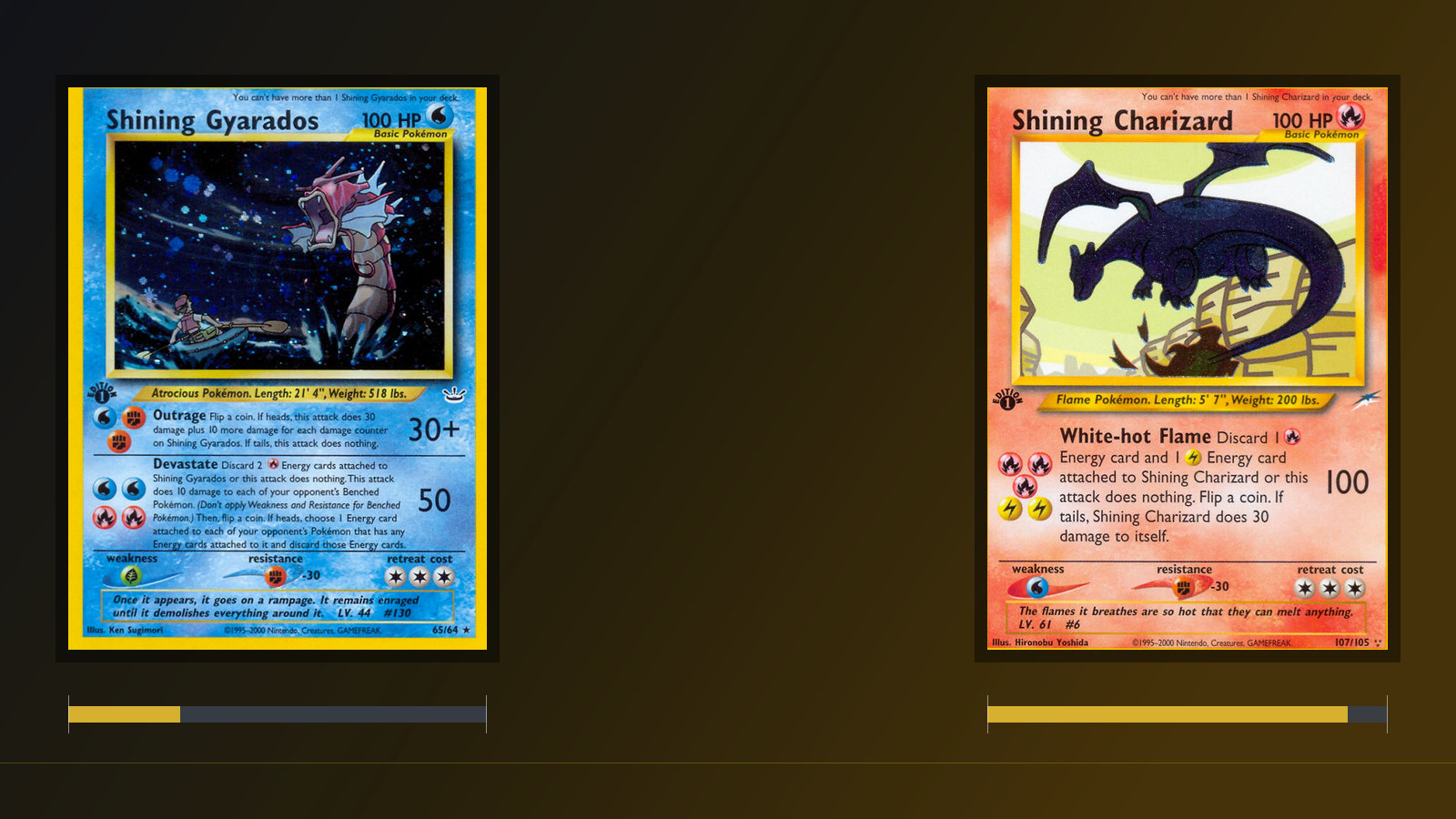
Shining Gyarados, card 65 of 64 in the English Neo Revelation set of September 2001, printed in a stamped run and an unstamped one, is graded on a foil field filling its whole artwork window. The unlimited print turns the copies that reach a PSA 8 into tens at a third of the rate managed by eight Shining cards printed five months later, whose foil sits on the Pokemon rather than behind it. Both groups arrive at a grading desk in close to the same condition. Our tracker puts the older card at 4.4 percent and the nearest of the eight at 14.2 percent. I sorted both census blocks by the share of tens among copies that reached a PSA 8, because that measure sets the wrecked copies aside and asks only what a gradeable copy manages to do next. The ordering that fell out puts the cap on the printed face rather than on the lives the copies led.
What September of 2001 put past the end of the set
Neo Revelation reached English shelves on September 21 of 2001, carrying 64 numbered cards and two more the numbering declined to count. Shining Gyarados is 65 of 64 and Shining Magikarp is 66 of 64, a pair sitting past the printed total of the set that produced them. The pokemon-tcg-data card dump and the TCGdex set record, both of which I opened this session rather than trusting to memory, give Neo Revelation an official count of 64 against a true total of 66, and they agree on every date in this paragraph. The same two records put a first edition run across all 66 cards, so every Shining copy exists in a stamped printing and an unstamped one. Neo Destiny followed on February 28 of 2002 with eight Shining cards of its own. Those eight are the group the older pair gets measured against for the rest of this entry, and they sit past a printed total of 105.
One foil fills the window and the other does not
The Neo Revelation Shining pair carry the ordinary holofoil treatment of the era, which lays a cosmos foil across the entire illustration box and prints the artwork over the top of it. On Shining Gyarados that box holds a Ken Sugimori Gyarados rendered in pink above a kayaker, and every part of the field behind those figures is reflective. The eight Neo Destiny Shining cards invert the arrangement, putting a matt illustration in the box and restricting the foil to the silhouette of the Pokemon alone. I downloaded the high resolution scans of Shining Gyarados, Shining Charizard and the Neo Destiny holofoil rare Dark Typhlosion and looked at all three before writing a word of this, because a classification field in a card database is not the same thing as seeing where the foil actually sits. Dark Typhlosion shows the filled window and needs no magnification to show it. Shining Charizard shows a pale matt courtyard with a foiled dragon standing in front of it, which is the opposite arrangement on a card of the same line.
A foil layer fails in ways a matt surface does not, and those ways are specific enough to name. Reflective stock holds fingerprints, carries the fine parallel print lines left by the press, and takes scratches a grader finds under a raking lamp at angles an owner never uses. Every one of those faults scales with area, because a scratch landing anywhere inside a filled window lands on foil, while the same scratch on a Neo Destiny Shining card most often lands on ink. Border whitening and corner chipping do not separate the two groups, since both sit inside the identical yellow border used on English cards from 1999 to 2003. Sheet cutting drift does not separate them either, on the evidence available here. The two sets were cut within five months of one another to the same tolerances, which leaves the foil as the one thing that genuinely changed between the two printings.
Where this card sits among its own sheetmates
Something peculiar to this one card would have put it below its own sheetmates. Among the 16 holofoil rares in the unlimited Neo Revelation run, counted from the worst upward, Shining Gyarados ranks 14 by the share of tens among the copies that reached a PSA 8. The other 15 pool to 2.3 percent on that measure against the 4.4 percent this card manages, which makes it one of the stronger converters in its own block and still leaves it far below every one of the eight. It does that while carrying the worst conditioned submission pool of the sixteen, with only 31.1 percent of its copies reaching a PSA 8 at all. A card converting at nearly twice the pooled rate of the fifteen sheetmates cut in the same run, on the same stock, at the same moment, is not being held back by its own illustration or by where it happened to sit on the sheet. The cap it shares with all sixteen is the single feature all sixteen have in common, which is a foil field filling the artwork window.
Shining Gyarados against Shining Charizard
Shining Gyarados and Shining Charizard make the tightest comparison this era offers for a question about foil. Both are Shining cards, both sit past the printed total of their own set, both came out of English boosters within five months, and both have been graded in comparable numbers. Our tracker counts 8,535 submissions on the Gyarados against 7,806 on the Charizard, which is near enough to treat the samples as equals. Of those, 31.1 percent of the Gyarados copies and 34.7 percent of the Charizard copies reached a PSA 8, a gap of a few points on a shared scale. The two cards were therefore kept and stored about as carelessly as each other across the twenty five years since they left their packs. Among the copies clearing that bar, 4.4 percent of the Gyarados came back tens against 14.2 percent of the Charizard. Two populations arrive in comparable condition and leave at rates a factor of three apart.
The ladder, counted twice in two sets
The comparison repeats inside each set, which is what moved this from one observation into something worth stating as a claim. Neo Destiny holds all three foil arrangements at once, cut in a single run and sold in the same boosters, so its own census ranks the three without any help from me and without any comparison across sets. Its 16 holofoil rares with filled windows pool to 6.5 percent, and its eight Shining cards with foil on the Pokemon alone sit well above that figure. Neo Revelation produces the same ordering, with its holofoil rares at the bottom and its 37 unfoiled cards pooling to 33.1 percent at the top. Foil area rises and the share of gradeable copies converting into tens falls, in both sets, across both print runs, without a single reversal anywhere in the ordering, which is the shape of a dose response rather than of a coincidence. The same measure separated the crystal secret rares in the last expansion Wizards of the Coast ever shipped, which is where this column first put it to work.
The rung I would not lean on
The unfoiled cards in both sets are commons and uncommons, and almost nobody mails a damaged common to a grading company, which selects those submission pools before any grader sees them. They are therefore screened far harder than a chase card's pool, which lifts the top rung of the ladder by an amount this data cannot measure. I would not rest the argument on that rung, and the argument does not need it, because the two Shining groups are chase cards selected in the same way as one another. A second limit is that a census counts grading outcomes rather than surfaces, so no row here proves a scratch rather than a soft corner took any particular copy down. The foil reading explains the ordering better than anything else tested against it. It remains an inference drawn from grades rather than a measurement taken from cards, and hobby lore about Neo era foil scratching easily was not tested here at all.
What the count stands at today
The census counts 8,535 graded copies of the unlimited Shining Gyarados and 118 tens among them. The stamped printing is scarcer and grades better, with 2,375 copies counted and 8.8 percent of its gradeable copies reaching a ten. Both figures move every week as more copies are mailed in, and both are read live from our tracker rather than typed onto this page, on the terms set out in how these census figures are counted. The stamp decides nothing about the surface, which is what the stamped Lugia of December 2000 showed on a different sheet of the same series. A surviving copy carries a pink Gyarados over a starfield, inside a yellow border that still squares up, on a sheet of foil holding every mark it has ever taken.