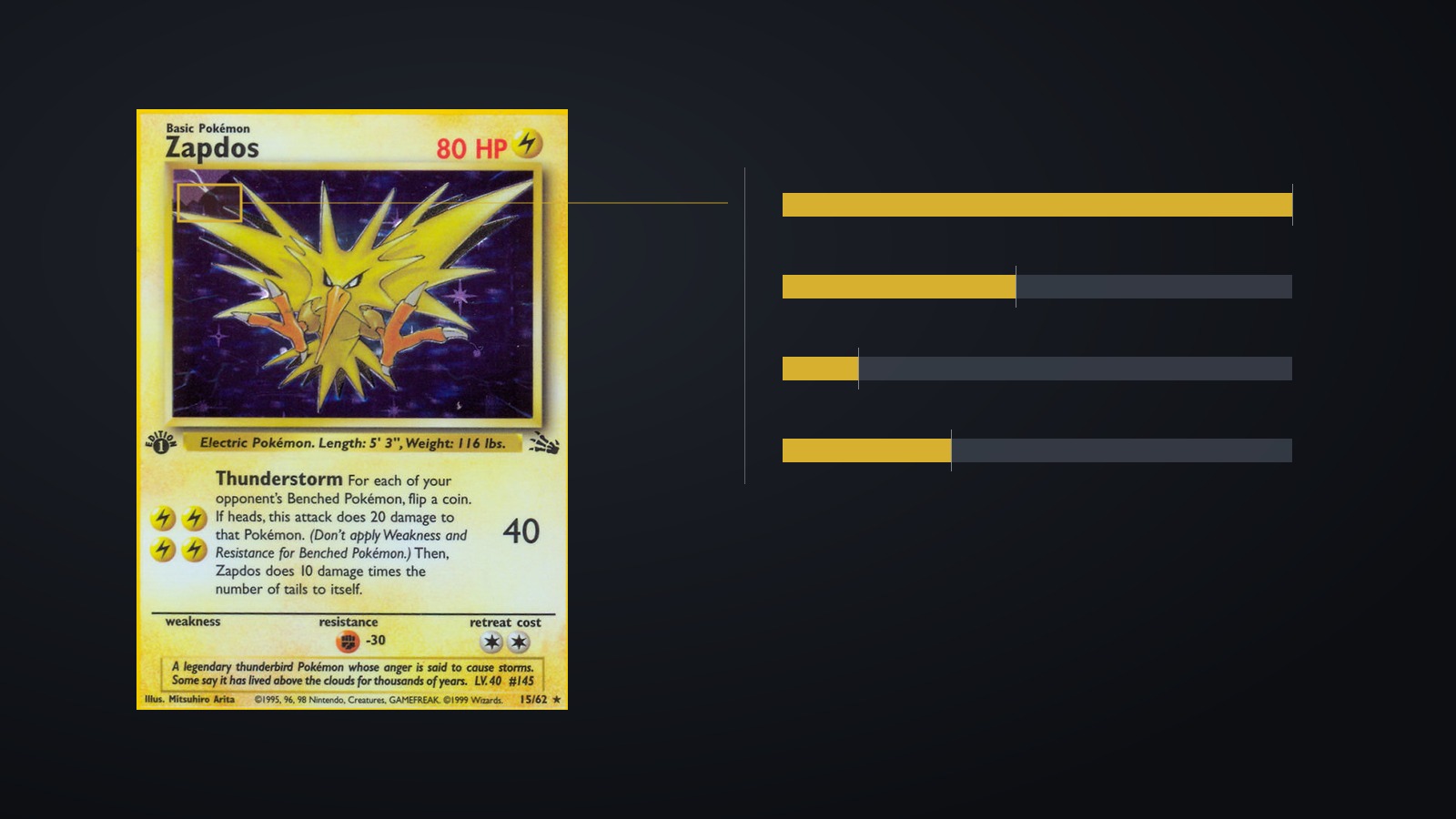
Zapdos, card 15 of 62 in the English Fossil set of October 1999, holofoil print, carries a rectangle of missing foil in the upper left corner of its artwork window. What caps this card is the dark holofoil field it shares with every other Fossil holo, and the gap between its two unlimited labels measures how PSA sorts them rather than how they wear. The Fossil Zapdos PSA 10 count divides across four separate grading labels rather than resting on one, which is the first thing I had to sort out. Three of those labels sit on the unstamped printing, and the fourth belongs to the first edition printing, which left the factory with that rectangle intact on every single copy it produced. I pulled all four rows this run, and the plain rates they return fall from 6.4 percent at the top to 0.6 percent at the bottom. A gap that wide across one illustration printed in one factory inside about a year invites a conclusion about the foil, and the trailing thirty days of intake underneath it will not carry one yet.
What Wizards of the Coast shipped in October of 1999
Fossil reached English shops on the tenth of October in 1999 with 62 cards, the third expansion printed after Base Set and Jungle. I took that date and that count off two records this run that do not share a source. One is a local copy of the pokemon-tcg-data card dump and the other is the live TCGdex entry for the set, and the pair agree on the day and on the printed total of 62. Card 15 is a Zapdos illustrated by Mitsuhiro Arita, whose full graded catalogue sits on his Artist Spotlight page. The set ran first in a stamped edition and then in a much larger unstamped one, which was the ordinary two stage arrangement Wizards of the Coast used across this whole period. What is unusual about card 15 arrived inside the unstamped run rather than at release, and nothing about the printed face records it. The mask controlling where holofoil landed on this card was recut partway through that run, so one card number covers two physically different surfaces.
The rectangle of missing foil, and where it sits
Zapdos is a Basic Pokemon and has no evolution box, meaning the small panel a Stage 1 or Stage 2 card carries at the upper left of its picture. Collector guides to this card attribute the fault to a mask cut as though card 15 did carry one, and that explanation stays lore here rather than record, because no publisher document says so. What I can state is what I read off the scans, which I opened at full size this run and compared corner against corner. On the earlier surface a rectangle sits in the upper left of the picture with no foil beneath it, so the printed art inside reads flat and pale against the starfield around it. The boundary between the two is a straight vertical line rather than anything an illustrator would have drawn. On the later surface that rectangle is gone and the foil runs unbroken to the gold inner frame. The first edition printing was never recut, and PSA issues no corrected designation against it, which is the one piece of the hobby account that the grading labels themselves confirm.
Four labels on one illustration, counted apart
The first edition print has returned 378 tens off 5,892 submissions. The uncorrected unstamped print has returned 119 tens off 4,982, and the corrected unstamped print 20 tens off 3,615. A fourth label sits beside those three, carrying a scatter of coloured flecks across the window instead of the starfield, and I read its copyright line off a product photograph this run as 1999 to 2000. That flecked label stands at 2,903 graded copies today and has produced 38 tens across its whole recorded history. Measured against copies that reached a PSA 8 at all, which is the same question asked of gradeable survivors only, the four run 9.4 percent, 4.3 percent, 1.4 percent and 3.1 percent. Arriving in gradeable shape is itself uneven across them, with 55.6 percent of uncorrected submissions reaching a PSA 8 against 40.1 percent of corrected ones. That second figure is the one worth stopping on, because a rectangle of foil cannot make a card arrive more beaten than its twin and something else therefore has to account for it.
The Fossil Zapdos PSA 10 rate against its own sheetmates
Fourteen other holofoil rares were printed alongside card 15, on the same stock, cut on the same equipment and opened by the same children. Among the unstamped prints of those fifteen cards, this Zapdos ranks 13 of 15 on tens among gradeable copies, where the count runs upward from the weakest card on the sheet rather than downward from the best. The block behind it converts at 2.5 percent against this card at 4.3 percent, with the weakest of the fourteen being the Lapras at 1.0 percent and the strongest the Muk at 5.9 percent. The stamped prints order themselves the same way, with card 15 ranking 11 of 15 against a block converting at 7.2 percent. I ran both of those rankings expecting the foil fault to drag card 15 down below its own sheetmates, and the ranking refuses to do it on either printing and on either measure. Whatever the missing rectangle costs, it is smaller than the ordinary distance between two Fossil holos that were cut from the same sheet on the same afternoon.
Thirty days of intake, and what that does to the comparison
A population count answers how many copies a label holds, and the trailing thirty day count answers how fast it is still taking them, which turns out to matter more here. Read as a share of the standing population, the four labels on card 15 took 1.6 percent, 0.2 percent, 2.6 percent and 1.8 percent over the last thirty days. The uncorrected unstamped label is the second figure in that list, and it has very nearly stopped. Its fourteen sheetmates on the same printing ran between 1.0 percent for the Hypno and 3.0 percent for the Gengar across the same window, averaging 1.6 percent. So the label carried by card 15 sits below every single one of the controls I have. Cards described as corrected foil start appearing in the completed PSA 10 tape in June of 2023, and one 2025 listing on that tape says in its own title that the slab is a corrected foil card wearing the wrong label. Taken together those two readings say the split between the two unstamped labels is still being written, and a population still being sorted cannot be read as a measurement of how two surfaces wear. The corrected label is also holding a late cohort by construction, since every copy graded before the designation existed went into the other pile, and the copies still being submitted after twenty seven years are not the ones that were set aside clean in 1999.
The foil that every card in this set carries
Setting the four labels aside and taking Fossil whole, the foiled cards in the set hold 228,449 graded copies and return tens at 2.5 percent. The unfoiled cards of the same set hold 157,753 copies and return tens at 19.5 percent. Those two groups were printed in the same months, cut by the same machines, bordered identically in yellow and pulled from the same packs, and the only systematic difference between them is a reflective layer inside the picture. A dark holofoil field is where a scratch, a scuff or a press line shows under a raking lamp instead of disappearing into matte ink, and Zapdos sits on one of the darkest windows in the set. That is the mechanism capping card 15, and I know it because the same cap sits on all 36 foiled rows of this set at about the same rate. The unfoiled rows of the identical set run far better than that on the two figures just given. The same comparison runs through the Shining Gyarados, whose foil fills the artwork window rather than sitting behind the Pokemon, and it falls out the same way there.
Fourteen completed sales, and one tape I decline to take a median from
Price comes last in this column and it arrives with its sample size attached. The completed table on PriceCharting for the corrected product, read on the sixth of November 2026, holds fourteen PSA 10 sales running from July of 2023 to December of 2025, with a median of 513.82 dollars and a range from 227.50 to 1,299.00 dollars. Fourteen trades across twenty nine months is a short list rather than a market, and saying so out loud is the only honest way to print the figure. I am not quoting a median off the uncorrected product's table, because at least two of its thirty PSA 10 rows are titled as Base Set cards and a third describes a corrected foil slab. That tape mixes two different products the same way the grading labels themselves do. The raw column on the corrected product is the steadier of the two readings, holding thirty ungraded sales with a median of 20.00 dollars and a newest row from the twenty ninth of October 2026. None of this is financial advice, and the same thin tape problem sits under the Base Set Machamp, whose ceiling was settled on the cutting line rather than in anybody's hands.
What the window still holds
Today card 15 survives in 5,892 stamped graded copies and 4,982 uncorrected unstamped ones, with the corrected label standing at 3,615 and the flecked one at 2,903. The rectangle sits in the upper left of every stamped copy ever printed, flat and pale beside the foil around it. On the recut surface the starfield runs edge to edge inside the gold frame, and tilting the card until the light moves is the only way to separate one from the other. The holofoil keeps the record of everything that has happened to it since October of 1999, which on a dark window means every hairline that a matte card would have swallowed. Across the whole history of the card, 378 stamped copies have come back at the top of the scale and 119 uncorrected unstamped ones, out of the 228,449 foiled Fossil cards that have passed a grading desk. The surface decides it, and the surface has been deciding it the same way for twenty seven years.