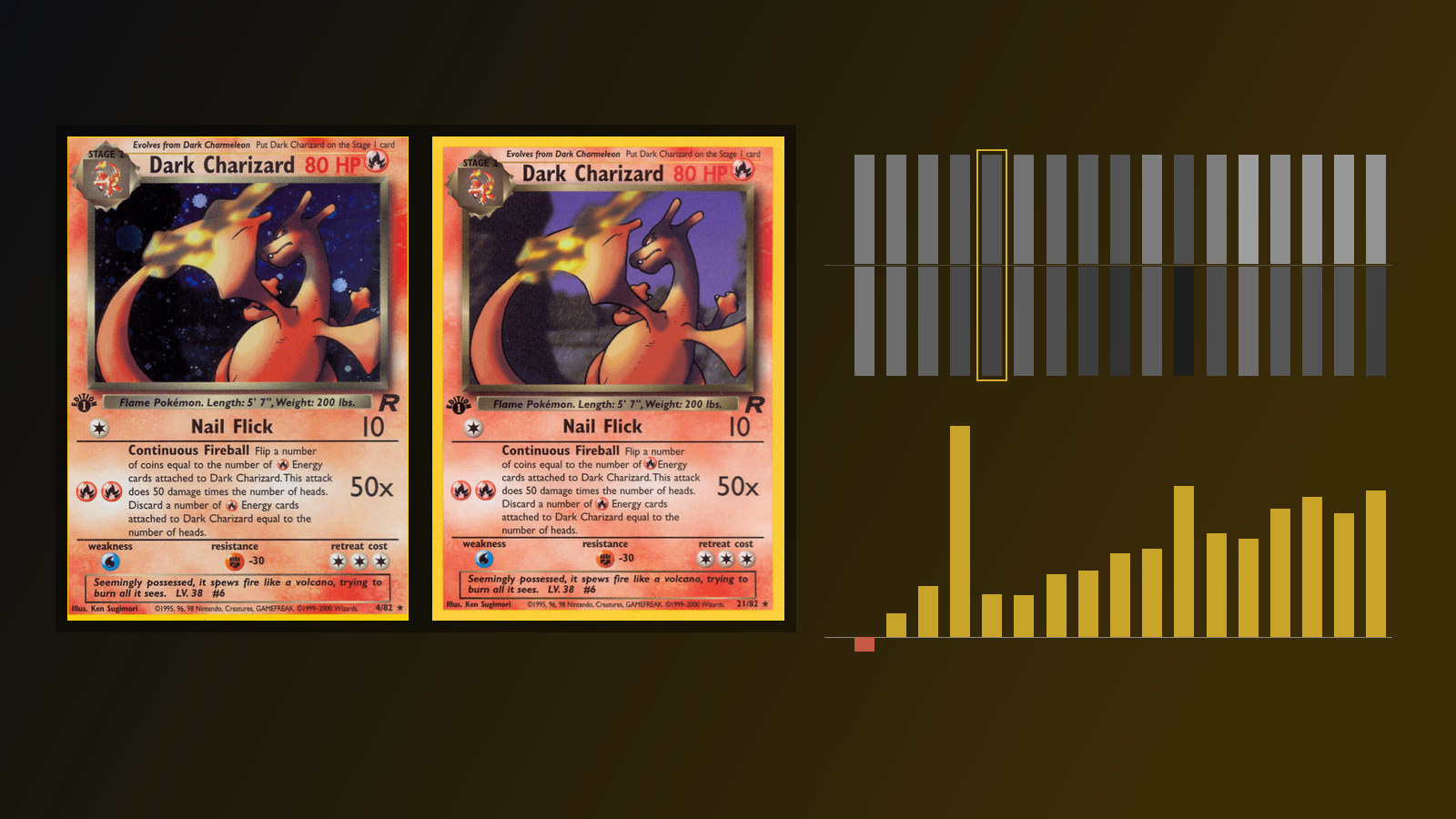
Dark Charizard, card 4 of 82 in the English Team Rocket set of April 2000, holofoil print, sits behind a night sky window that the publisher darkened so the foil underneath it would read. What separates Dark Charizard's two PSA 10 populations is the print run each copy came out of, and the holofoil everybody names costs this card less than it costs most of its own sheet. Team Rocket printed nearly every one of its holofoil rares a second time without foil, under a different card number inside the same expansion. That arrangement leaves seventeen matched pairs in the census, each carrying one Pokemon committed to two different surfaces. I pulled every Team Rocket row from our population data this run, opened all thirty four of the paired scans at full size, and measured the average brightness of each illustration window. The foiled member came back darker in all seventeen pairs, and the size of that darkening tracks the grading penalty closely.
The set that printed nearly every holofoil card twice
Team Rocket reached English shops on the twenty fourth of April in 2000 carrying 82 numbered cards and one more printed past the end of them. I took that date and both of those counts off two records this run that do not share a source. One is the local copy of the pokemon-tcg-data card dump and the other is the live TCGdex entry for the set, and the two agree on the day, on the printed total of 82 and on the full total of 83. The eighty third card is a Dark Raichu, and it stands as the first card the English game ever numbered past its own set total. Eighteen holofoil rows sit in our population data for this expansion, and seventeen of them have a twin inside the same set that carries no foil whatsoever. Cards 1 through 14 are the foiled Dark Pokemon and cards 18 through 31 repeat those same fourteen Pokemon unfoiled, with three further pairs covering the two Trainers and the Rainbow Energy. Dark Raichu is the one holofoil card with no twin anywhere in the set, which is what arriving past the printed total meant in practice. Its stamped print stands at 8,082 graded copies today and returns tens at 3.0 percent.
The window Wizards of the Coast darkened for the foil
Card 4 and card 21 carry the same Ken Sugimori Charizard, whose whole graded catalogue sits on his Artist Spotlight page, the same eighty hit points and the same two attacks. The card frames are identical, and so are the attack text and the copyright row running along the foot of each one. What does not match is the picture behind the dragon, and I opened both scans at full size this run to be certain of it. On the foiled card the background is a black night sky scattered with pale stars. On the unfoiled card the same Charizard stands against a lit purple dusk where trees and a horizon line are visible behind its wing. Somebody took the decision to repaint that background dark for the foiled print, because a reflective layer under a bright picture washes the picture out and a reflective layer under a dark one reads as depth. I measured the mean brightness of the illustration window on all thirty four paired scans, on the ordinary zero to 255 grey scale, and the foiled member is darker in every single pair. The seventeen foiled windows average 81 against 117 for their unfoiled twins. Running that same measurement over the twinned pairs in Jungle and Fossil from 1999, together with Neo Discovery from 2001, puts the foiled window darker in 62 of 65 pairs across the four sets.
Seventeen matched pairs, counted on tens and measured on light
Taking the stamped run first, because it is the cleaner of the two, the seventeen foiled cards hold 94,301 graded copies between them and return tens at 5.92 percent. Their unfoiled twins hold 39,606 copies and return tens at 14.28 percent. The foiled member gems lower in 16 of the 17 pairs, and the single exception is the Here Comes Team Rocket Trainer at 21.6 percent foiled against 20.5 percent unfoiled. In the unstamped run the same comparison runs 1.48 percent against 4.87 percent and loses on 17 pairs out of seventeen, with no exception left standing. Then I ranked the pairs twice, once by how much darker the foiled window measured and once by how far the foiled rate fell below its twin, and the two orderings agree at a rank correlation of 0.70. The pair whose two windows sit nearest each other in brightness is that same Trainer, separated by under three points of grey, and it is the one pair where the foil costs nothing measurable at all. The loudest disagreement is the Dark Magneton, which gems at 1.3 percent foiled against 17.4 percent unfoiled on a brightness gap no wider than this Charizard's. One outlier in seventeen does not undo a correlation, and a correlation of 0.70 across seventeen pairs does not make brightness the only thing in play either.
Where the Dark Charizard PSA 10 rate sits among the seventeen
The stamped holofoil Dark Charizard has returned 555 tens off 12,222 submissions, which is 4.5 percent, and its unfoiled twin has returned 708 tens off 9,167, which is 7.7 percent. The foil therefore costs this card a little over half again on the plain rate, and that penalty is the fourth smallest of the seventeen pairs I measured. The brightness gap between its two windows is the fifth narrowest of the seventeen, which is close to what the correlation above would predict for a card losing that little. Measured against copies that reached a PSA 8 at all, which asks the same question of gradeable survivors only, card 4 converts at 7.6 percent and ranks 9 of 18 inside its own foiled sheet. The other seventeen foiled rows behind it convert at 8.5 percent together, running from the Dark Magneton at 2.2 percent up to Here Comes Team Rocket! at 25.4 percent. So the most valuable card in the set is an unremarkable member of it on the measure that holds the printed face constant. That reading is the opposite of the one I wrote up for the Base Set Machamp, a card that genuinely does finish last on its own sheet, and the contrast is what makes the ordinariness worth stating.
The stamp that sits on the better half of the census
The first edition stamp on this set is a small black oval set into the left margin of the card, below the illustration window and turned ninety degrees so that it reads upward. I read where it sits off the scan rather than off a guide, because a stamp is itself a grading surface and its placement decides what can go wrong with it. Ink that sits proud of the card stock can smear, and a stamp pressed into a margin that narrow leaves very little room for the cut to drift before the oval is off centre or clipped. Every expectation I brought to this card said the stamped print should grade worse than the unstamped one for exactly those reasons. The census says the opposite, and it says it without a single pair going the other way. Across all eighteen foiled illustrations the unstamped run returns tens at 1.40 percent against 5.69 percent for the stamped run, losing on 18 of 18 pairs. On this Charizard the two prints run 0.9 percent unstamped against 4.5 percent stamped, a gap of five to one on one Pokemon printed in one factory inside about a year.
The same gap, counted again on sixty five cards with no foil
A five to one split on a foiled card invites an explanation built out of foil, so the next thing to do is take the foil away and see whether the split survives. Team Rocket makes that cheap, because the set holds sixty five unfoiled illustrations printed in both runs, and not one of them carries a reflective layer anywhere on its face. The unstamped prints of those sixty five return tens at 6.69 percent against 17.45 percent for the stamped prints of the same cards. The unstamped side loses on 65 of 65 pairs, which is every one of them. Dark Charizard's own unfoiled twin runs the same way, at 2.5 percent unstamped against 7.7 percent stamped. So the run gap has nothing to do with foil, it survives on cards that have none, and it is comfortably larger on this Charizard than the foil penalty the matched pairs measured. Set whole against whole, the foiled rows of Team Rocket hold 210,671 graded copies and the unfoiled rows hold 199,052, which is the sample every comparison in this piece has been drawn out of and the reason I trust the direction of it more than the size.
What this census cannot separate
Two explanations fit the run gap equally well on the numbers I have, and the honest move is to put both of them down rather than pick the flattering one. The first of the two is the press that ran the unstamped sheets for far longer. An unstamped run that ran later and much larger than the stamped one could plausibly have drifted on registration and on the cut, and nothing in a population count would show that drift as anything other than a lower rate. The second explanation is the decision a collector makes about which copies are worth a grading fee. A stamped Dark Charizard has been worth the fee for decades and an unstamped one has often not been, so the stamped pile is screened before it is mailed and the unstamped pile carries far more of whatever was in the shoebox. Our data leans the second way without settling it, because 59.5 percent of stamped submissions reach a PSA 8 at all against 35.5 percent of unstamped ones, and copies that arrive beaten were beaten long before PSA saw them. Intake points the same direction, with the unstamped print still taking in 2.1 percent of its standing population every thirty days against 1.4 percent for the stamped one. The census window under every population figure here closes on 2026-10-01, the method behind the rates is set out on our methodology page, which explains how a gem rate is calculated here, and none of this is financial advice.
What the foil still does under a raking lamp
Card 4 survives today in 12,222 stamped graded copies and 19,862 unstamped ones, against 9,167 and 9,891 for the unfoiled twin that shares its dragon. The night sky behind that dragon is the darkest thing on the card and the only part of it that reflects, which is a combination that hides nothing at all. A hairline the matte picture absorbs sits on the foiled window as a bright line, and the deeper the black underneath, the brighter that line reads when the card is tilted. On card 21 the same Charizard stands in daylight on flat ink, and a scratch there has nowhere bright to sit. The Fossil Zapdos, whose own window is missing a rectangle of foil in one corner, carries the same dark field and behaves the same way under a lamp. A reprint comparison built on matched pairs of a different kind sits in the Base Set 2 Blastoise, where the later press loses every foiled pair and wins most unfoiled ones. Twenty six years of light have been falling on both of these surfaces in the same drawers and binders, and only one of them keeps the record.