Ancient Mew, the unnumbered Cosmos holofoil promotional card handed out at cinemas in 2000 for the international release of The Power of One, is graded on a face that is foil from edge to edge. What caps the Ancient Mew PSA 10 population is the press that made it rather than the handling its copies received, and five other cards given away at the same kind of cinema counter are the evidence for that. I pulled every English cinema giveaway of the Wizards of the Coast era out of our tracker this morning, then opened the largest scan of each one I could find. That leaves six objects distributed the same way, through a ticket counter rather than through a hobby shop, across a window of nineteen months. Four of the six carry no foil at all, and I confirmed that against a scan of each. One carries foil everywhere except its own artwork, the last carries foil across every square millimetre of its front, and the release history for each of the six came off its own encyclopedia entry rather than off anything I remembered. Every population figure printed below is dated to the recount it was counted in.
What the cinema counter handed out in July of 2000
The encyclopedia entry for this card records it as given out with the purchase of a ticket for the theatrical run of The Power of One, in the United States and other countries worldwide, at participating cinemas within the first week of release. After that first week the same entry says attendees would only be able to receive a Moltres, Articuno, or Zapdos instead, which puts a hard edge on how long the card was available at all. The international copy arrived sealed in a plastic wrapper alongside a teaser card for the Pokemon League, so a large share of the surviving population never met a binder page. No document from Wizards of the Coast states how many were made, no figure repeated in the hobby traces back to one, and a print run total for this card therefore belongs among the things collectors say to each other rather than among the things anybody can look up. The same entry separates the international print from the Japanese one at the border, noting that the international pattern is more pronounced and does not extend to the card edge because that border is wider. The width of that border matters again further down this page, more than once. It is the part of the object a grader measures against the cut, and on this card it is unusually wide and unusually symmetric.
A front with no matt area anywhere on it
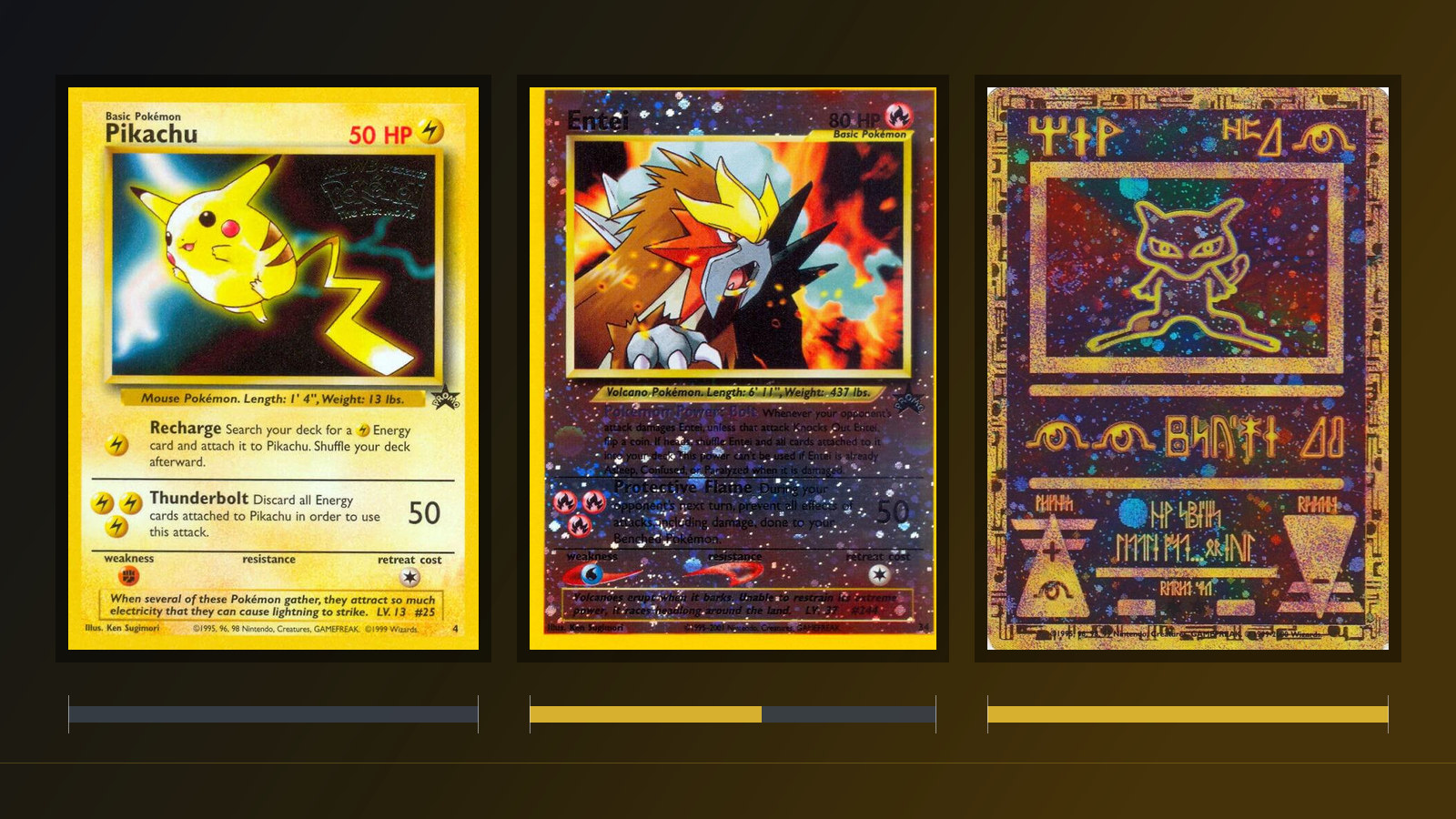
I opened a sixteen hundred pixel scan of the 2000 print before writing any of this, and the foil runs the whole way out to all four cut edges. There is no yellow border on this card and no white text box, because the runic frame and the glyph panels and the artwork window and the copyright line all sit on top of the same Cosmos foil. Border whitening and chipping, the mechanism collectors name first on a card of this age, behaves differently here than it does on an expansion card from the same years. On a yellow bordered card the exposed white core is close in tone to the ink beside it, and on this one a chipped edge opens a white line against dark foil. Holofoil scratching is therefore the one mechanism on this card with nowhere at all to hide. A lifted line anywhere on the front lands on foil rather than on flat ink, and print lines from the press cross the entire face rather than one window. Neither fault has a quiet corner of the card to happen in, which is a problem the 2002 set that filed a holo and a non foil print under one card number never has to deal with. Cutting drift decides where that wide patterned border lands against the four edges, and a symmetric frame makes a small drift legible from across a table.
Four non foil promos from the same counter, nineteen months earlier
The four cards handed out with a ticket for Mewtwo Strikes Back from November 10 of 1999 are the control this argument needs, and I checked each of their faces the same way. Those four are ordinary yellow bordered cards printed in flat ink, each carrying a gold stamp reading Kids WB Presents Pokemon The First Movie inside the artwork window. Not one square millimetre of any of them is foil, and they reached collectors through the same kind of counter and into the same kind of hands, nineteen months before this card existed. Electabuzz has returned 881 tens from 7,496 graded copies at 11.75 percent, and Pikachu 1,151 tens from 11,155 copies at 10.32 percent. Mewtwo sits at 9.24 percent off 11,293 graded copies and Dragonite at 8.61 percent off 13,478 of its own. Ancient Mew has returned 3,933 tens from 86,514 graded copies, a rate of 4.55 percent, which is around half of what the flat ink cards manage. The share of each card that a grader placed at 7 or lower then runs the other way entirely, and that reversal is what rules out an explanation resting on handling.
The grades underneath the eights
A card destroyed by handling collapses beneath the 8 line, because a rounded corner or a crease or a scuffed surface is a fault that arrives long after the pack was opened. A card held back at the press banks up at 8 and 9 instead, since the only thing standing against an otherwise untouched copy is its geometry or a fault in its factory surface. Dragonite put 41 percent of its graded copies at 7 or lower, Mewtwo 40.3 percent, Pikachu 38.1 percent and Electabuzz 34.3 percent. Ancient Mew put 32.3 percent of its 86,514 graded copies down in that band, which is lower than every one of the four cards that reaches a ten around twice as often. The promo with the fewest beaten copies is also the promo with the fewest tens. No account of this card resting on rough handling survives that pair of figures, and where the counts themselves come from is set out on the page describing our data sources.
The reverse holofoil that lands in the same band
Nineteen months after Ancient Mew the same company put a second foiled card across a cinema counter, and its encyclopedia entry calls that card the first Reverse Holofoil card released outside Japan. Entei, card 34 of the Wizards Black Star Promos, was given away with a ticket for the theatrical release of Spell of the Unown from April 6 of 2001 for as long as stocks lasted. I opened its scan beside the Mew, and the arrangement is the exact inverse of it, with foil laid over everything except the illustration window and that window printed flat in ordinary ink. It also keeps the yellow border that Ancient Mew does not have, which makes it a foiled card body sitting inside an unfoiled edge. Entei has returned 1,031 tens from 22,692 graded copies at 4.54 percent, against 4.55 percent for the Mew, and the two of them were made a year apart by one company for one purpose. Two cards with opposite foil arrangements sit in one low band, and the four flat ink cards sit in a band roughly twice as high.
Where the Ancient Mew PSA 10 population stalls
A population report says more in its middle than at its top, and the middle of this one is where the mechanism finally shows itself. Graders have placed 30,897 copies of Ancient Mew at 9 and 3,933 of them at 10. That is close to eight nines standing behind every single ten, where the four flat ink promos of 1999 stand at roughly three, and I computed each of those ratios off the same census rows rather than reading them anywhere. A copy that reaches 9 has already survived twenty six years of somebody's storage. What stopped such a copy one grade short is a fault small enough to leave its corners and its edges and its gloss intact, which on this object means the cut or the surface of the foil. The same reading of a middle rather than a top runs through our read on the December 2000 Lugia decided at its corners. Ancient Mew is also still moving, with 2,031 fresh gradings added in the thirty days before the recount dated 2026-09-07, which is more in one month than any one of the four 1999 promos holds in tens.
The same illustration, printed again in 2019
The strongest test of a claim about a press is to run the same design through a different press, and this particular card happens to offer exactly that. Ancient Mew was reprinted in Japan for Mewtwo Strikes Back Evolution in 2019, with the same runic layout and the same outlined Mew, and with foil once again carried out to all four edges. I opened that scan as well, and its foil texture is a denser speckle rather than the Cosmos pattern, so the two prints are related objects rather than identical ones. The census counted 2,211 tens from 3,786 graded copies of that 2019 print, a rate of 58.4 percent, and it sits among the other promotional cards in the promo gallery on this site. A design reaching a 10 more than half the time on a modern press is not inherently ungradeable. What separates the two prints is nineteen years of change in cutting tolerance and in foil application and in card stock, and naming those three is the same thing as naming the 2000 press as the cap.
What this reading cannot separate
The census tells manufacture and handling apart, and it does not tell the two manufacturing faults apart at all. A copy dropped from 10 to 9 for its centring and a copy dropped for a print line across its foil arrive in the very same column of the very same report. Separating those two would take a run of dual graded copies carrying published subgrades, which PSA does not print on a standard label, and I hold no such run and found no published one while looking for this piece. The 2019 comparison also rests on 3,786 graded copies against 86,514, drawn from a different market of submitters, so it points rather than proves. The reading that survives all of that is narrower than the heading above it, because the fault is at the press and which of the two press faults dominates is unresolved here.
What survives from July of 2000 is a card that reads as extraordinary across a table and gives itself away the moment a lamp is turned onto it. The Cosmos foil still throws its blue and green flecks over the runic border and the glyph panels and the copyright line alike, because no flat ink interrupts it anywhere on the front. A chipped border edge opens a white line against that foil which is legible at arm's length, and fine parallel print bands cross the entire face rather than one window. Copies at 8 and 9 are the ordinary outcome of a submission, 23,730 and 30,897 of them respectively at the recount dated 2026-09-07. The tens stand at 3,933 against 86,514 graded copies, which is the whole of what a quarter of a century has produced. The object a cinema lobby handed over in 2000 is a sheet of foil with a card cut out of it, and every one of those cuts is still being read.