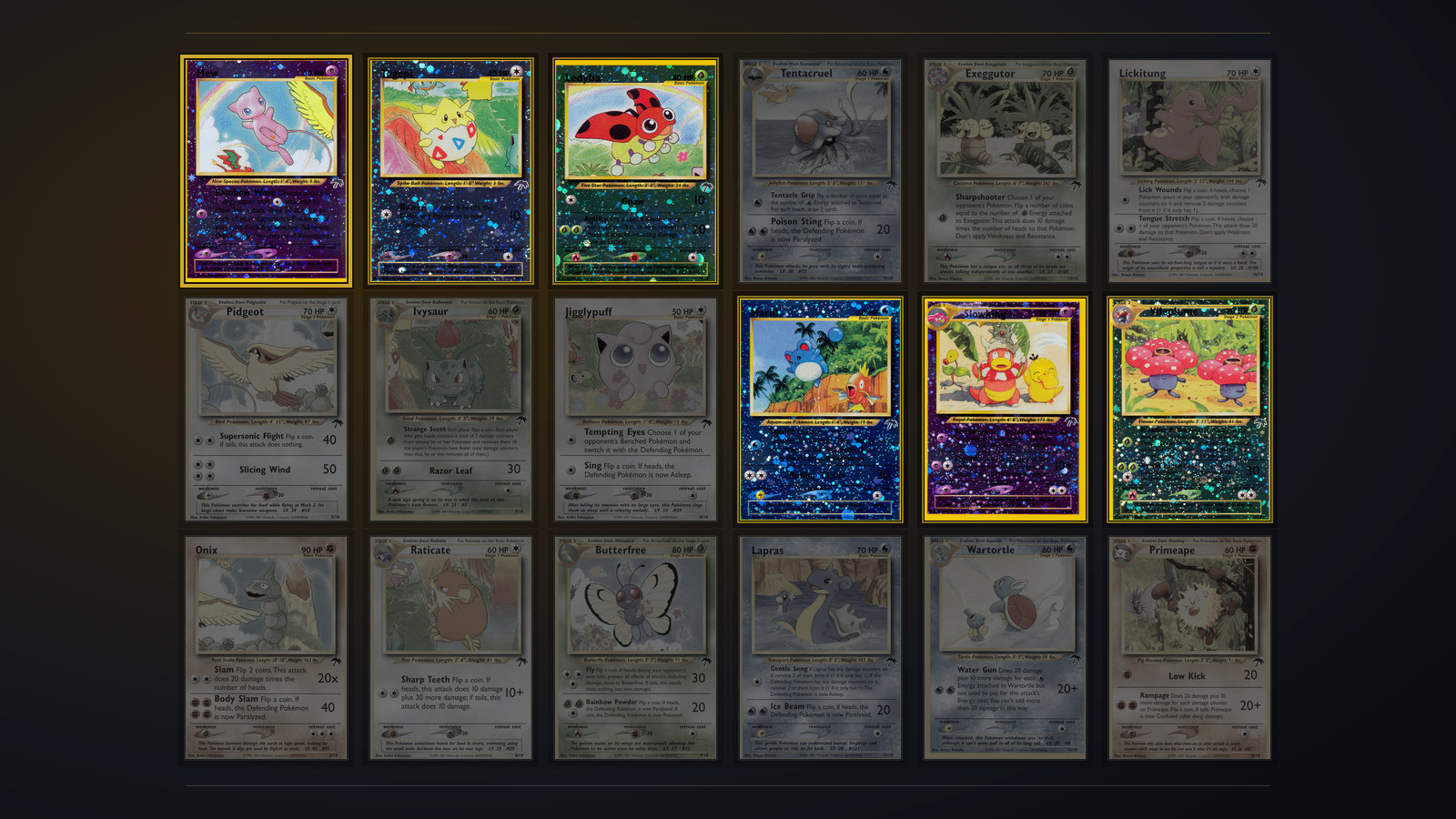
Mew, card 1 of 18 in the English Southern Islands Collection of July 2001, holographic print, is graded on a foil field covering its whole face except the picture. The Southern Islands Mew is capped by the foil field on its face rather than by its border or its packaging, and the twelve unfoiled cards that shipped inside the same binder are the evidence. I have sorted enough of this set to expect the chase card to arrive beaten, since a card people want is a card people handle. What the census shows is narrower than that and a good deal harder to argue with, because it runs across more than thirty thousand graded copies of one sealed product. Every other set of the era mixed its foiled and unfoiled cards out of a booster pack. That leaves the foil tangled up with how many copies were printed and with who bothered to mail one to a grader, where this collection sold one of each card to every buyer at a single price, in sleeves, inside a binder.
The binder, and what the publisher listed inside it
The publisher kept a product page and a short question and answer page for this set, and I read both this week off archived captures from 2001. Wizards of the Coast listed the contents in one sentence: a three ring binder, eighteen game cards previously only in Japanese, six postcards, three randomized booster packs from recent expansions and protective sleeves cut to fit the binder. The same page sets a suggested retail price of 19.99 dollars and answers the foil question flatly, that six of the eighteen new cards are holographic. An asterisk on the checklist marks which six, under a legend reading Holo, at card numbers 1, 4, 7, 11, 14 and 17. A separate answer explains the arrangement, which is that the eighteen are separated into six sets of three, each trio depicting the scene printed on one of the six postcards. That puts exactly one holographic card inside every three card scene, and all eighteen into one buyer's hands at once. The local card database, the marketplace catalogue this site prices against and the publisher's own capture agree on a release date of July 31 in 2001.
Foil everywhere except the picture
I pulled the official scans of all eighteen cards at full resolution and set the six marked holographic beside the twelve that are not. On an ordinary holofoil card of this era the foil sits inside the artwork window alone, a rectangle of perhaps a fifth of the face, with everything around it printed matt. These six inverted that arrangement, so the artwork window became the one matt region and the starfield foil filled the whole remaining face inside the yellow border, running behind the name, behind the attack text, behind the weakness strip and down into the copyright line at the bottom margin. The field underneath is dark, a deep violet dropping to near black at the corners of the text box, which is the least forgiving surface a press can hand a grader. Sellers call these cards reverse holo about as often as they call them holo, which is hobby usage rather than the publisher's own word for them. The twelve unfoiled cards carry the same yellow border and the same white text box, and nothing on their faces catches light at all.
What this collection holds still
A population table can rarely separate the press from the decades that followed it, and this one rules a great deal out before any arithmetic starts. Border whitening and chipping go first, because all eighteen share the same flat yellow border. Stamp variants go next, since no first edition run of this collection was ever made, the census files all eighteen under a single printing, and there is no shadow or symbol variant anywhere in the set to sort them by. Edge wear from stacking is ruled out by the contents list itself, because the sleeves and the binder shipped in the box alongside the cards. Supply is held still here by arithmetic rather than by anybody's argument about it. The twelve unfoiled cards have each been graded between 1,012 and 1,244 times, a range of under a quarter across twelve different Pokemon.
That is what a fixed ratio looks like on a census, and it is the one thing the first edition Lugia measured against the eighteen holofoil rares cut beside it could never claim. Those nineteen cards came out of packs at rates nobody outside the printer has ever published. Here the ratio is one to one, eighteen times over, for every copy of the product that sold. The buyers are the same people, the storage is the same binder, the twenty five years since are the same years, and the only thing separating the two groups of cards is whether a face catches light. What remains after all of that is the foil and the sheet under it.
The penalty, counted at three heights
Our tracker keeps a curated population table for the whole Wizards of the Coast era, and I ran the foiled six against the unfoiled twelve at three separate thresholds rather than at the usual one. Counting every copy ever submitted, 85.8 percent of the unfoiled cards came back at a PSA 8 or better against 52.1 percent of the foiled ones. Restricting the count to those survivors, the unfoiled cards turn 28.6 percent of them into tens where the foiled cards turn 2.8 percent, which asks the same question of gradeable copies alone. Across everything submitted the two rates are 24.6 percent and 1.4 percent, from 13,006 graded copies of the twelve and 17,353 of the six. The penalty for carrying foil does not sit at one height on the scale. At the PSA 8 line the foiled cards are short by nearly two fifths, and at the top of the scale they are short by an order of magnitude. That shape belongs to surface rather than to structure, because a creased or badly cut card fails low on the scale where these six are only mildly behind. A card marked across a dark foil field still passes a grader at an 8 and at a 9, and it stops on the last step, which is the exact height at which the distance between these two groups opens up.
Mew against its own five siblings
Mew is the worst grader of the foiled six and the deepest graded card in the collection, with 5,306 copies submitted against 2,977 for Slowking, the next deepest count of the six. Of those, 20 have come back as tens, a rate of 0.4 percent, and 60.5 percent of everything sent in failed to reach a PSA 8 at all. Ledyba at card 7 is the healthiest of the six, graded 1,876 times for a gem rate of 3.3 percent. Part of that distance is selection rather than printing, and the mechanism behind it is ordinary enough to name. A Mew in rough shape is still worth the postage where a Ledyba in the same shape is not, so the Mew count collects beaten copies the other five never see. What selection does not explain is what happens above the PSA 8 line, where the comparison no longer contains a damaged card at all. Among copies that did reach an 8 or better, Mew makes tens at 1.0 percent against Ledyba at 4.8 percent, and submissions have not slowed since, with 173 fresh grades added to the Mew count in the trailing thirty days.
No other set of the era can test this
The gap between foiled and unfoiled cards is not news by itself, and it turns up in some size in every Wizards of the Coast set on our table. Gym Challenge of October 2000 is the narrowest, with its foiled cards making tens at 13.0 percent against 14.2 percent for the unfoiled ones. Base Set 2 of February 2000 is the widest, at 0.9 percent against 22.8 percent, and the Blastoise reprint whose foiled pairs lost to their own 1999 originals took that one apart. Neither set can say what its own gap is made of, and nor can any of the others, because a holofoil rare arrived roughly once a pack where a common arrived eight at a time, so the two halves of a set never shared a supply in the first place. Different supply brings different survival and different owners and a different reason to mail a marginal copy anywhere. The Southern Islands Collection is the one product of the era where a buyer opened a box and owned exactly one of each card. Its gap is the cleanest measurement of the era's foil penalty the census makes available, which is a better reason to write this set up than the price of its chase card.
The sheet, which this cannot rule out
One mechanism survives everything above, and the honest version of this piece gives it the room it deserves. Holofoil cards in this era were laid out and trimmed on their own foiled sheet, so the unfoiled twelve rule out the binder and the sleeves and the buyers without ruling out a worse trim. Centering drift and surface marking land on the same six cards and widen the same gap. A census cannot read the spiral collectors call a swirl either, an artifact of the foil layer that half the completed listings advertise in their titles and that no grade line records. No population table built from the outside can tell those two apart, and I have never found a printing document for any of it, so the accounts in circulation of how these sheets were run stay hobby lore rather than record. The claim here is the narrow one, that whatever caps these six travels with the foil and leaves the twelve beside them alone, and the notes setting out how this site assembles a card census give the provenance of every column behind it.
Four completed rows under the top line
Price arrives last here and arrives small, because a card with this few tens has a short list of trades rather than a market. The graded ladder I read on October 1 of 2026 runs 363.82 dollars ungraded, 1,580.00 dollars at a PSA 8 and 4,622.98 dollars at a PSA 9. The nine line has thirty completed sales behind it stretching back through June of 2026, which is enough for a median to mean something. The ten line stands at 85,001.00 dollars and rests on four completed rows going back to 2022. One of those four is a sealed postcard rather than the card, and of the three that remain, two landed in May and July of 2026 and the third landed in 2022 at a small fraction of them. The headline figure therefore records a pair of recent trades rather than a level anything changes hands at, and since none of this is advice of any kind, the calculator that works a submission through the current fee tiers is where the arithmetic of mailing one belongs.
What is left on the copies that survived
What sits in front of a grader today is a card whose entire working surface throws light back. Tilt one and the starfield moves behind every line of text on the face. A mark laid into that surface at any point in twenty five years reads as a dull streak across a dark field instead of hiding in white card stock. The yellow border holds its colour and takes its corner wear slowly, exactly as it does on the twelve matt cards filed behind it in the same binder. On those twelve a comparable scuff simply disappears, and the matt artwork window in the middle outlasts everything around it. Of the 5,306 copies of this Mew that have reached a grader, 20 carry a ten and 500 carry a nine. The copies that came out of their sleeves intact still show the press before they show the hands.