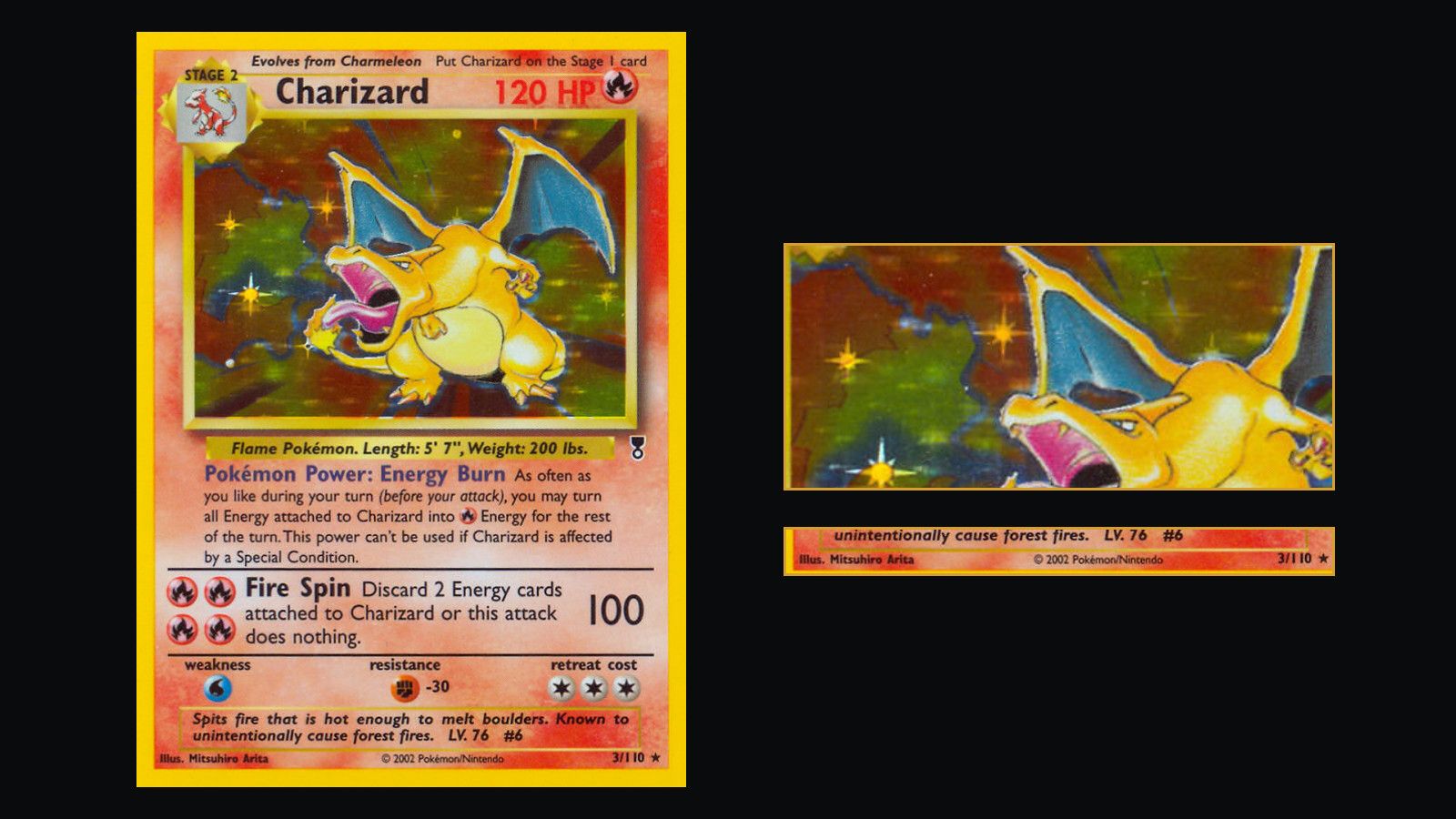
Charizard, card 3 of 110 in the English Legendary Collection of May 2002, holofoil print, is a card whose grade is decided at its four corners rather than inside its foil window. The Legendary Collection Charizard is capped by handling wear rather than by its foil, and the non foil print of the same card in the same set is the evidence for it. Three separate prints of this one card went into English packs during that spring. I pulled the three rows out of our tracker this morning and read the set's release history beside them, and what the three rows do together is hold the paper stock, the cutting year and the print run constant while varying only the foil. That makes card number 3 a controlled comparison rather than an anecdote, and very few cards from this era offer one at all. Every figure below carries the date on which it was counted, and not one of them came out of memory.
What Wizards of the Coast put in packs in May 2002
The release history I read this morning dates the English Legendary Collection to May 24 of 2002 and counts 110 cards in the set. Every one of them is a reprint of a card from Base Set, Jungle, Fossil or Team Rocket, which is why the frame around this Charizard is the yellow bordered original rather than anything drawn up in 2002. The set is also where the English game received its first reverse holofoil prints, which that history describes as cards carrying holofoil throughout except the artwork window. The same page calls that pattern fireworks like, and it is a fair description of what the scan shows at full size. Collectors call it cracked ice instead, which is hobby usage rather than anything a printer wrote down, so the two are worth keeping apart. What the release history does not carry anywhere is a print run, and no figure for how many Legendary Collection packs were made has ever been published, which makes every set total quoted in the hobby lore rather than record.
Three finishes filed under one card number
I opened the largest scan of the holofoil print I could get and looked at where the foil actually sits on the object. On that print the foil is confined to the artwork window, which leaves the yellow border, the text box and the whole lower third of the card as flat matte stock. The reverse foil print is the exact complement of that arrangement, foiled everywhere except the window, and the plain print carries no foil anywhere at all. Otherwise the three are the same card, cut the same year, on the same stock, from the same reprint of the same Mitsuhiro Arita illustration that ran in 1999. Our tracker holds a separate row for each of them, and the three rows are nowhere near each other. Graders have seen 3,332 copies of the holofoil print and sent 17 of them back as tens, which is 0.51 percent, while the reverse foil print has produced 87 tens from 4,700 graded copies.
Four mechanisms, and the fingerprints they leave
Most lost grades on English cards of this era come from four physical mechanisms, and each of them leaves a different mark on a population report. Cutting drift across the uncut sheet throws the borders out of square and reads as centring, which parks otherwise clean cards at an 8 or a 9 and rarely lower. Holofoil scratching lifts fine bright lines out of the foil layer and is what a grader looks for when the card goes under a raking lamp. Border whitening and chipping expose the white core of the card along its edges and its corners. Edge and corner wear from twenty years of stacking rounds the card off and takes it out of contention for anything high, no matter how clean the face looks. Border whitening is the mechanism that caps the dark bordered Neo holos of 2000, and it is doing very little here, because Legendary Collection inherited the yellow border of the sets it reprints and there is far less dark ink on the edge to chip away.
What the three finishes measure that one card cannot
Inside card number 3 the foil carries a real and measurable cost, because the same card exists in the same packs without any. The holofoil print reaches a ten 0.51 percent of the time and the plain print reaches one 2.61 percent of the time, off 3,295 graded copies, so taking the foil away multiplies the odds of a ten by roughly five. That gap is the scratching mechanism with a number attached to it, and it is the only one of the four mechanisms that these three rows can isolate cleanly on their own. The gap does not explain the card, though, because 2.61 percent is a dismal figure for a card carrying no foil at all. That same tracker covers 92 non foil Legendary Collection cards, and across 15,391 graded copies of them a ten comes back 25.69 percent of the time. The non foil Pikachu from the same set, the same stock and the same year sits at 28.65 percent off 754 graded copies, which is more than ten times the rate of the Charizard printed alongside it.
The shape of the grades underneath the tens
A population report says more in its middle than at its top, and this is where the four mechanisms separate. A card held back by the cut banks up at 8 and 9, because its surface and its corners are untouched and the only thing wrong with it is the geometry of the frame. A card held back by handling collapses underneath that band instead, and I counted the remainder on each of these rows to see which shape they take. The holofoil row put 65.9 percent of its graded copies at 7 or lower and the plain row put 68.6 percent of its own down there too, against 25.3 percent for the set's non foil cards as a group and 16.8 percent for that Pikachu. Two thirds of every Legendary Collection Charizard ever submitted came back below an 8, and cutting drift cannot explain a gap that wide against a Pikachu printed and cut in the same run. That is not a card losing a point at the border, and the same reading holds on the 1999 original, where 106,701 graded copies have produced 0.46 percent tens with 75.4 percent landing at 7 or lower.
What the census counts today
The holofoil row carries a recount date of 2026-10-01, and on that count 3,332 graded copies hold 17 tens between them. Submissions have not stopped, either, with 61 fresh grades added to the holofoil print and 118 to the reverse foil print in the thirty days before that recount. The set as a whole has 457 holofoil tens across 19,861 graded copies of its 19 holofoil cards, so this Charizard is well under its own set's rate rather than merely at the bottom of a bad set. Where those figures come from, and how often each one is recounted, is set out on the page describing our data sources. The illustration itself is worth its own look, and the rest of the catalog Mitsuhiro Arita drew for the card game sits on his page here. Anyone weighing the numbers above against a modern card will find the same counting habit applied to a modern promo in our read on what the Tag Team GX census showed, and the money side of a resubmission worked through in the arithmetic of cracking a graded nine.
What survives from 2002 in any quantity is a Charizard whose foil window still reads clean under a lamp and whose corners no longer do. The tens are a different object from that, 17 of them at the last recount, and they are not what an ordinary 2002 binder produced. Copies at 6 and 7 are common enough to be unremarkable, and the distance between that band and the top of the scale is the whole of this card's story. The foil scratches, the yellow border carries less contrast against an exposed white core than a dark border does, and the corners give out first. Card 3 is an easy card to find and a hard card to find flat, square and sharp at all four corners.