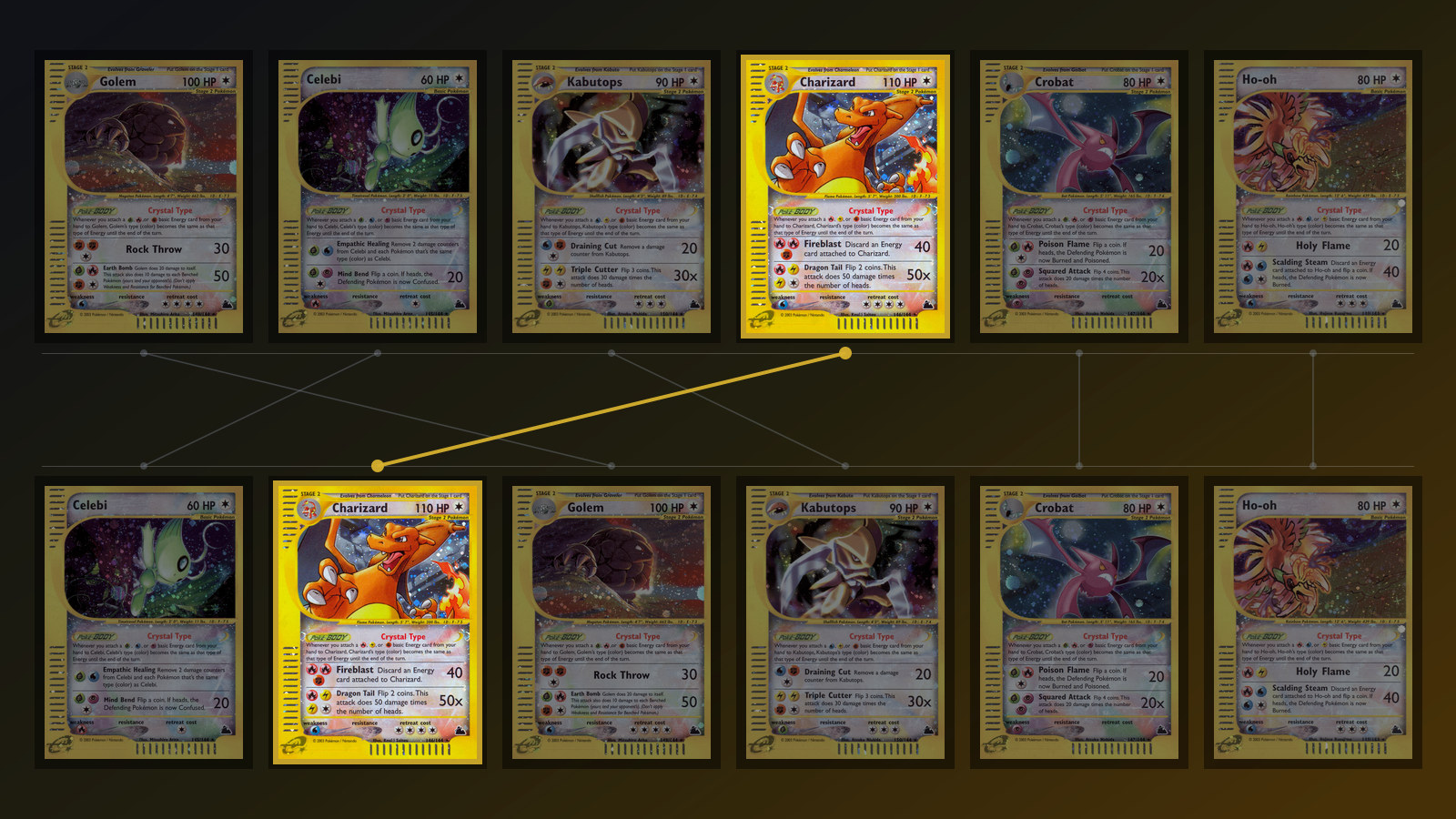
Charizard 146 of 144, the Crystal Type secret rare of Skyridge in May of 2003, carries holofoil under its attack text as well as under its artwork. Wizards of the Coast printed six of those secret rares into that expansion and then printed nothing else in English ever again. The Skyridge Crystal Charizard PSA 10 rate is set by the share of copies that never reach a PSA 8, and among the copies that do reach one it produces tens at close to the best rate in its own secret rare block. PSA has returned 249 tens against 1,732 submissions of the standard holofoil print, which is 14.4% of everything sent in. At first glance that reads like a card the press simply treated badly, but the census says something a good deal narrower than that, and the five crystals cut alongside it are what separates the two readings. I sorted all six of them twice while writing this, once on the plain rate and once on the rate among copies that reached a PSA 8.
The last expansion Wizards of the Coast ever shipped
Skyridge reached English shelves on May 12 of 2003 with 144 numbered cards and six secret rares. I read that set metadata off the card dump this site already carries rather than off a hobby page. Bulbapedia records the same release day and states that Skyridge was the final expansion produced by Wizards of the Coast before the company lost its licence. The Japanese expansions it was assembled from had gone on sale the previous August and October, and EX Ruby and Sapphire followed on June 18 of 2003 as the first expansion distributed by Nintendo of America. That leaves about five weeks between the last Wizards release and the first one under Nintendo. All six secret rares carry the Crystal Type rule box and appear in the census twice, once as a standard holofoil print and once as a reverse holofoil one. What collectors say about the size of that print run is lore rather than record, because no printing figure was published for the era.
Foil that runs under the attack text
I put a scan of the Crystal Charizard beside a scan of Alakazam H1, an ordinary holofoil rare from the same expansion. The whole difference sits in the lower half of the two faces. On the ordinary rare the foil stops at the bottom edge of the artwork window, and the text half below it is printed on flat matte stock. On the crystal the foil carries straight down past the Crystal Type rule box and under the attack lines, so the sparkle sits plainly visible behind the black text even at six hundred pixels wide. Only the yellow border is matte here, which leaves close to four fifths of the front as foil under a thin clear varnish. A scuff across the lower half of an ordinary Skyridge rare lands on paper and vanishes into the printed texture of its text box, while the same scuff on a crystal lands on foil and catches a raking lamp from every angle.
The dot code at two of the four edges
Both of the Skyridge scans I read this week carry a machine readable dot code printed on the front of the card. It is a dense band of short dark bars running down the left edge and across the bottom beneath the copyright line. On the Crystal Charizard both bands reach to within a millimetre or two of the trim, which is an unusual place to put dense black print on a card with a yellow border. Whitening on a yellow border normally shows as a pale fibre line and wants a lamp held at an angle before it reads at all. Against a black dot code band the same whitening shows as a broken bar, so edge wear on a card printed this way is visible at arm's length and survives into a scan. Whenever I sorted stock from these three expansions I expected the bottom edge to be the first thing gone, because that strip draws the eye and sits where a card is pushed out of a binder pocket. That is a different failure from the one the 2002 Legendary Collection Charizard runs into at its four corners, and different again from the stamp edge that separates the printings of the first edition Neo Genesis Lugia.
The Skyridge Crystal Charizard PSA 10 rate
Of the 1,732 standard print copies in the census dated 2026-09-11, 922 came back graded below a PSA 8. That is 53.2% of everything ever sent in on this card, and the block below an eight is larger than every copy graded 8 or better on it put together. The rest of the ladder runs 249 tens and 348 nines with 197 eights beneath them, and the reverse holofoil print of the same illustration adds 1,540 submissions more, gemming at 8.4%. Set against its own expansion the gap is plain, because the non foil Skyridge cards carry a below eight share of 9.3% across 21,868 submissions and gem at 37.6%. The holofoil half of the expansion sits between them, with 34.3% of its 34,954 submissions landing below an eight. A census built on that much damage measures what happened to the cards after the pack at least as much as it measures the press, and the notes on how these census figures are derived say where each number comes from.
Six crystals from one sheet, ranked twice
On the plain gem rate the six run Golem at 18.3%, Celebi at 17.9% and Kabutops at 15.3% ahead of the Charizard at 14.4%. Crobat at 9.7% and Ho-Oh at 7.9% sit below it, which places this Charizard fourth of six on the figure everybody quotes. Ranked instead on the share of tens among copies that reached a PSA 8, Celebi leads at 32.4% with the Charizard immediately behind it at 31.4%, and Golem falls to 29.3% with Kabutops at 25.7% under that. Crobat at 18.3% and Ho-Oh at 16.4% stay where they were at the bottom of both lists. Nothing about the press moved between those two orderings, because all six were cut from the same secret rare sheet in the same months with the same foil treatment. What moved is the denominator, and the cards that fall down the second list are the ones whose copies arrived in better shape.
What the census cannot separate from price
A top copy of this Charizard was quoted at $99,000 on PriceCharting when I read the product page this week, against $8,031 for the Golem printed beside it. Both figures come off product pages I opened the same afternoon, which is where our board for the gap between a nine and a ten takes its price legs. That difference decides which damaged copies are worth a grading fee at all, and it is the honest objection to reading the below eight share as handling alone. A Charizard with soft corners and a whitened bottom edge is still worth mailing at almost any grade, while a Golem in that state is not, so this census collects wreckage that the Golem census never sees at all. Conditioning on a PSA 8 takes most of that effect out, because a copy that reached an 8 was worth the fee on any of the six. It does not take all of it out, and I cannot separate the remainder from what the census shows me; the reverse holofoil print is the other control available, returning tens on 20.1% of its eight or better copies against 31.4% for the standard print.
What is left on the surviving copies
The foil field is the part of this card that keeps, and it keeps better than the paper around it. It runs from the top of the artwork down past the attack text, and it holds its sparkle on copies whose yellow border has gone pale at all four corners. The dot code along the bottom is the part that does not keep, because it sits at the trim and records every push into and out of a binder pocket as a broken bar. Between those two facts sits a census of 1,732 submissions, 922 of which never reached the grade at which centring and foil become the question. The 249 tens are the copies on which the press and twenty three years of storage both went right.