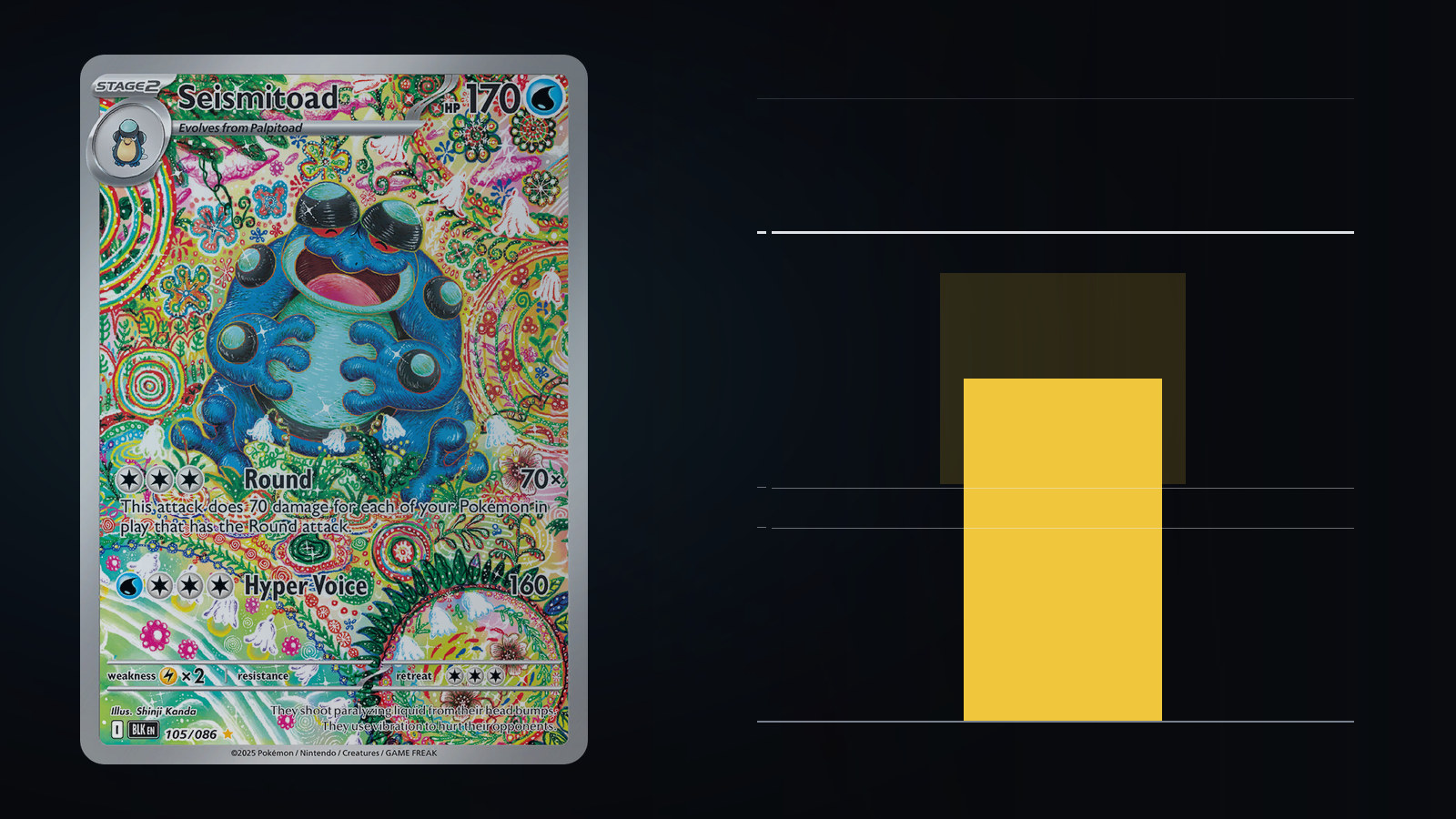
September 30, 2026, Seismitoad 105, one nine, 430.63 dollars.
That total is a PSA 9 at the price our own PSA 9 board carried this morning, plus a grading fee I don't get to choose. Cracking a PSA 9 Seismitoad 105 loses money at the trailing gem rate, because the value of a ten forces the submission into PSA's Express tier. The default answer in this column is hold, and this week the argument for it sits in a single line of PSA's terms rather than anywhere in the card itself, which is not where I expected to find it. That board prints a breakeven of 8 percent on this row, and it computes that figure at a service level this particular card is not allowed to use.
PSA decides which tier this card is allowed to use
PSA's pricing page, read this morning, puts Standard at 59.99 dollars against a thousand dollar insured value, on an estimate of 90 to 100 business days. Priority sits above it at 79.99 dollars and covers 1,500 on an estimate of 70 to 80 business days. Express costs 199.00 dollars and covers 2,500 on a much shorter estimate of 20 to 30 business days, which is the tier this card ends up in. Value services are still paused, so those three tiers are the whole ladder open to anybody.
The cap is not a suggestion you can quietly ignore to save a hundred and forty dollars. PSA's terms and conditions, section two, tell you to select a service level whose maximum insured value is greater than your estimate of the post grading fair market value of each item in the order. The same section says PSA can decide at any point that an item exceeds the cap you picked and then require the adjusted fee. Refuse to pay it and the card comes home unprocessed at your cost, billed at the level you submitted it under. A Seismitoad 105 that comes back a ten is worth well over 1,500 dollars, so Standard and Priority are both gone before you seal the envelope.
That constraint is the unusual part of this particular week, and it is most of the reason the card is here at all. On almost everything this column looks at, the fee is yours to pick. Here the card's own upside reaches up and selects the expensive tier on your behalf, and there's no version of the submission where you keep the fee small and the ten too.
430.63 dollars, at the only tier that covers a ten
A PSA 9 of this card carries 231.63 dollars on the board, and Express costs 199.00, so you are all in at 430.63 dollars before postage either way. You're also destroying a graded card to get there, which is worth saying in plain words, because the nine in your hand is the thing you are actually spending. The one thing the expensive tier gives back is time, and 20 to 30 business days is roughly six weeks against the five calendar months Standard would ask for. On a card whose price has been moving, six weeks of queue instead of five months is worth real money, and I'll come back to exactly what this card's price has been doing since August.
For scale, the fee is 46 percent of the entire 430.63 dollar outlay. The Steven's Metagross ex 289 piece this column ran three weeks ago turned on a fee that took half the distance between the two grades, and that felt like the extreme case when I wrote it. This one is worse in a quieter way, because nothing about the fee changed. The card's ceiling rose until it crossed a line in a contract, and the contract picked the invoice.
A ten leaves 1,663.88 dollars and a nine leaves 201.52
Sell the ten and the marketplace takes thirteen percent between its cut and the cost of posting a slab, which is the assumption our board runs on. A ten at 1,912.50 dollars therefore leaves 1,663.88 in your hand once that thirteen percent is gone. A returned nine, sold the same way, leaves 201.52, which is 229.11 less than you paid to try. So a hit clears about 1,233 dollars and a miss costs about 229, which is better than five to one on the two outcomes.
That shape is genuinely attractive, and it's the reason this row sits high on the board at all. Better than five to one is the kind of payoff that gets people cracking slabs before they finish the rest of the arithmetic. The catch is that you still have to reach the ten itself. Weight the two outcomes at the trailing rate and the average payout comes to 362.38 dollars against 430.63 paid, which is a loss of 68.25 a card.
The trailing rate is 11 percent and the line sits at 15.7
GemRate's published trailing figure for this card is 11 percent, measured over a window that closed on September 16 and covered 320 new grades. The lifetime rate across every copy ever submitted is 15.8 percent off 6,933 grades, so the recent month has been running some way under the card's own history. Breakeven at Express is 15.7 percent, and the distance between those two numbers is the whole of the decision. At Priority the line would be 7.5 percent and at Standard 6.2, which is exactly why the board, computing at the cheaper fee, reads this row as one that clears.
Three hundred and twenty grades is a real sample rather than a handful, and it puts a 95 percent interval of roughly 7.6 to 14.4 percent around that 11. Every point inside that interval sits below the 15.7 percent the fee is asking for. I ran my own count on the census rather than taking the published rate on trust. GemRate's live page this morning shows 7,103 PSA grades with 1,110 tens, against 6,983 and 1,099 in the copy I stored on September 16, which is 11 tens out of 120 new grades, or 9.2 percent.
A fortnight of 120 grades is a small window and I'm not going to pretend it settles anything by itself. It does agree with the published trailing figure and it disagrees with the lifetime one, which is the direction that matters on a card being considered for a resubmission. Both readings put the recent gem rate in single digits or low double digits, and neither of them gets anywhere near 15.7 percent.
A second read of every price, taken the same morning
The board's prices come off a weekly snapshot, so I opened the card's PriceCharting page again before publishing any of this. That page shows an ungraded copy at 211.00 dollars, a grade nine at 205.56, and a PSA 10 at 1,795.63, with both graded legs under the stored figure. TCGplayer's market price for the same raw card is 218.95 today, within four percent of PriceCharting's ungraded read, and that agreement is what tells me the two sources are describing the same product. The check exists because our own data once carried a Champion's Path Venusaur V at more than four thousand dollars when the card was really worth forty.
The realised sold tape on that same page says it a third time. PriceCharting lists thirty PSA 10 sales going back to August 10 at a median of 1,877.50 dollars, and thirty PSA 9 sales since September 3 at a median of 215.50. Split those thirty tens by month and August medians 2,025.00 across fourteen sales while September medians 1,775.50 across sixteen, so the top grade has given up around 250 dollars in a month. Run the calculation on those live legs instead and breakeven moves out to 16.3 percent, further from the trade clearing.
That agreement is the entire point of reading every leg of this twice. Two separate price sources land on the same answer, and so do two separate readings of the gem rate, with a stored snapshot standing beside a live one. Not one of those checks needs any of the others to be correct. I would rather publish a hold that four independent reads agree on than a crack that only one of them supports.
The two things that would change my answer
If PSA lifted Priority's insured value above 2,000 dollars, this card would clear at 7.5 percent and I would be writing the opposite piece. That's a condition rather than a forecast, and it's worth watching, because PSA rebuilt this exact table on September 14 and had already moved Express from 149.00 dollars to 199.00 inside the three weeks before that. The other route runs through the card, and it closes on you. A ten would have to reach about 2,626 dollars for breakeven to fall as far as the 11 percent this card actually gems at. That figure is over the 2,500 dollar cap on Express itself, so it lands you in the 349.00 dollar tier above, where the line moves back out to 18.2 percent.
So the card cannot grow its way out of this, at least not on the table PSA is running today. Somewhere between 1,500 and 2,500 dollars of gem value there is a band where a 199.00 dollar fee is survivable, and this Seismitoad sits at the wrong end of that band. Nothing above is a prediction about where the card goes next, and none of it is financial advice. Read the insured value cap first, then price the grading fee.