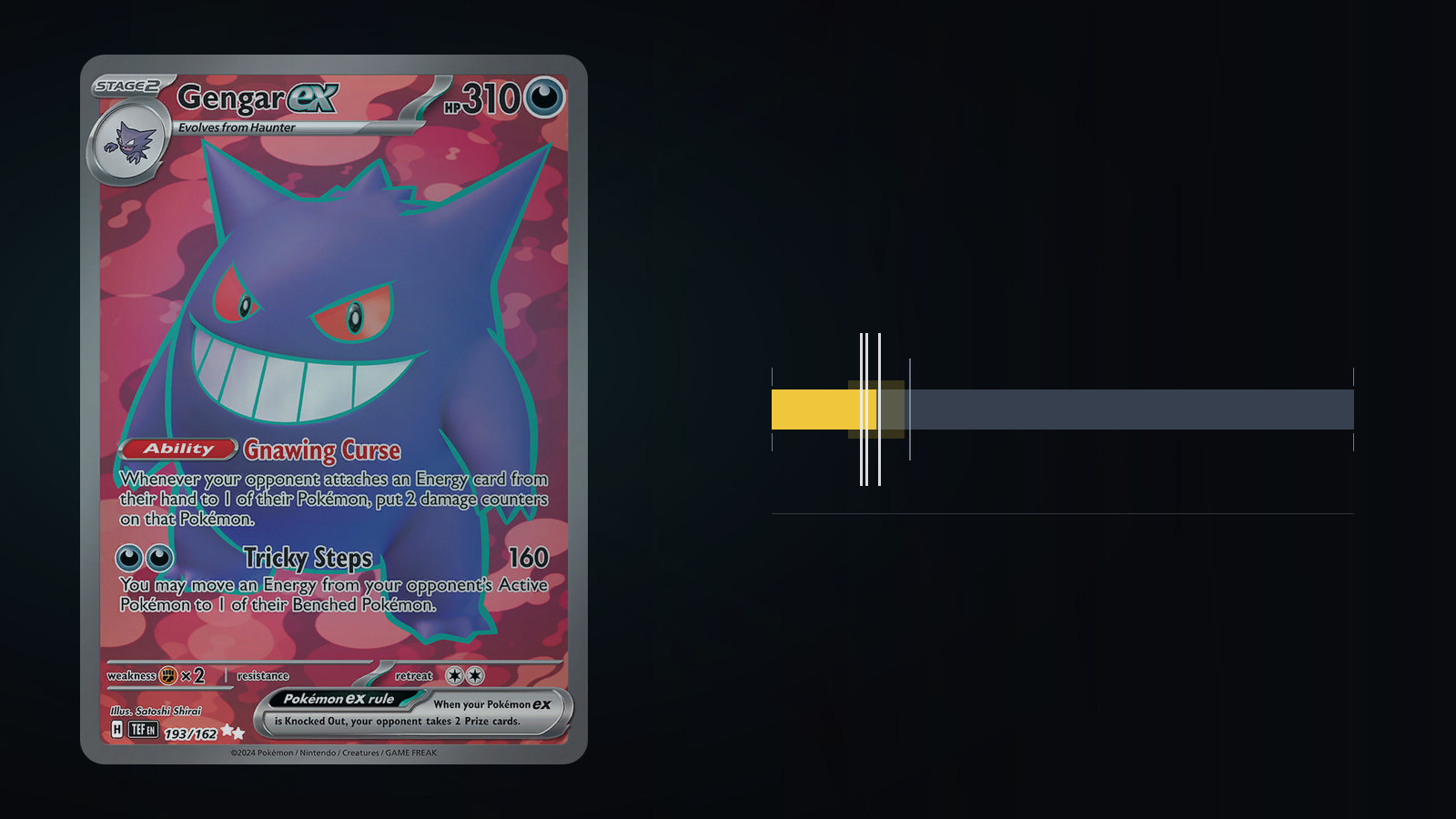
November 11, Gengar ex 193, two nines, $79.98 of fees.
Both of those submissions were the same card, cracked out of its holder once and mailed back a second time for nothing. A PSA 9 Gengar ex 193 sits half a point from its own breakeven, and the rate that decides it cannot be measured closely enough to answer the question, so I hold. Our board disagrees with me and prints this row as clearing by six points, which is the part worth your afternoon. We are both reading the same census, and only one of us is reading the right month of it.
What it costs to try, and the tier a $375 ten forces
PSA's pricing page, read this morning, opens at $39.99 for Value against a $500 maximum insured value, on an estimate of 90 to 100 business days. Standard costs $59.99 and covers $1,000 on 70 to 80 days, and Priority costs $79.99 and covers $1,500 on 50 to 60. Nothing on that table has moved since October 28, which is now three quiet weeks on a schedule that changed twice inside six months. The page still carries a heading announcing that Value services are paused, sitting directly above a live table that lists Value at $39.99, and a company article dated October 28 says the level reopened the next morning. I am going with the table and the article rather than the banner, and saying so here so you can check me.
Which of those three fees you may use is not actually your own decision to make. PSA tells you to pick a level whose insured value exceeds your own estimate of the card after grading, and a ten of this one sells at $375.00, so Value is legal with $125.00 of room. That room matters more than it looks, because $39.99 is the only fee at which this trade is arguable at all. The same rule once pushed a Seismitoad the other way, where the insured value ceiling shut a card out of the cheap tiers rather than letting it in.
The cheapest fee also buys the longest wait, and 90 to 100 business days is close to five months of somebody else holding your card. That queue is the reason I price the attempt at both of the bottom two tiers rather than only the one I want. A submission form is not a hedge against the ten falling while the card sits in California. One line is missing from everything below and I would rather name it: PSA's shipping schedule now sits behind a sign in, so add your own postage to every figure on this page.
What a ten pays, measured off 25 real sales
Our board carries this row at a PSA 9 of $72.99 and a PSA 10 of $378.74, and only one survives its own tape. PriceCharting publishes the completed auctions behind each headline figure, so I read both tables this morning. Twenty five sales with PSA in the title landed between October 23 and November 10 at a median of $375.00, running from $350.00 up to $440.00. The ten is therefore exactly right, which is rarer on this site than it sounds and worth saying when it happens.
The nine is the leg that moves once you check it against real sales. Twenty four PSA titled sales landed between October 21 and November 10 at a median of $74.00, running from $56.00 to $99.00, so the headline sits 5.6% low. Five of the 30 rows in that table were TAG, BGS or ACE slabs rather than PSA, and I dropped them before taking a median, because PriceCharting pools graders inside one grade column. Correcting the nine upward narrows the distance to $301.00 rather than the $305.75 our board subtracts, and that correction runs against cracking rather than for it.
I checked the card is the card before leaning on any of it. PriceCharting's raw price of $50.05 sits 1.3% under TCGplayer's market price of $50.71 for the same 193/162 Ultra Rare, which rules out a wrong product join about as cleanly as two sources can. That check exists because this site once caught a $4,230 price sitting on a card that really sells for $40.
Selling either grade costs about 13% between the marketplace cut and posting a slab, which is the assumption behind every row on our board. A ten nets $326.25 and a nine nets $64.38, so a successful crack is worth $261.87 and a miss hands back a fifth of that. A nine recovering only 19.7% of a ten is the shape that makes this kind of attempt dangerous, because almost all of the value of the card sits in the one outcome you cannot order.
Gengar ex 193 PSA 9 against three breakevens
If you already hold the slab the attempt costs the fee and nothing more, since the nine you give up is the nine you get back on the ordinary miss. Treat the outcome as a coin between a ten and a nine and the Value fee needs 15.27% of attempts to come home as tens. That treatment is too kind, because a cracked card can come back below the grade it already had. This card's own census says that among the copies which missed the ten, 82.5% were nines, 13.9% were eights and 3.6% landed at a seven or lower.
Price those three branches properly and the line moves to 16.26%. PriceCharting puts a Grade 8 of this card at $58.08 and a Grade 7 at $37.06, so the downside here is shallow in dollars even though it is real. A Dragonite in October showed how much a miss below the nine can cost when the grades under it sit further down. Raise the selling cut from 13% to 15% and the same line only reaches 16.61%, so the haircut is not what decides this one. Our board publishes 34% for this row because it prices every card at the Priority fee, and running its own formula at the Value fee gives 18.48%.
So there are three defensible answers to the same question, at 15.27%, 16.26% and 18.48%, and they sit 3.2 points apart. Step up one tier and the arithmetic changes character rather than degree. Standard at $59.99 needs 23.81% and Priority at $79.99 needs 31.35%, both of which this card misses by a distance no reading of the census could close. The question is live only at the fee whose own banner says it is paused.
Eighteen percent on 249 cards, and what that range allows
GemRate's trailing 30 day figure for this card reads 18%, on a window that closed September 16, across 249 grades. The lifetime figure reads 40.4% across 12,263 copies, with 4,954 tens and 6,010 nines, and quoting that one instead would make this look like a trade with twice the room it has. I corroborated the sample off the card's own weekly history rather than taking it on trust, and the last four weekly points add 229 copies against the 249 claimed. So the count is sound and the window is eight weeks old.
A share of 18% measured on 249 cards carries a 95% interval from 13.2% to 22.8%. All three of the Value fee breakevens sit inside that band, which means the measurement cannot tell you which side of any of them the real rate falls on. In money, a holder who sends this card nets $4.62 a copy at the middle of the range, loses $8.03 a copy at the bottom of it and makes $17.26 at the top. Same card, same month, same data, and a swing of $25 a copy depending on where inside its own error the rate actually sits.
I could not refresh that rate today and the reason is worth recording. GemRate returned a block on every attempt this morning, and PSA's own population report now sits behind a sign in, so there is no second door into a fresher count. Both of those are environment rather than evidence, and neither of them makes the September figure wrong. They do mean the figure deciding this trade is eight weeks stale on a card that has taken roughly 500 grades since.
One caution rides along with the rate every week and it never stops applying. A gem rate of any vintage describes raw cards their owners picked out of sleeves and sent in hopeful. A slab that PSA has already looked at and declined to call a ten is a different experiment, with a defect a grader already found and wrote down, and no published rate of its own anywhere.
The sample this question would need
Put the arithmetic the other way round and ask what a reading precise enough to settle this one would actually have to look like. To push the whole interval onto one side of the 16.26% line you need roughly 1,868 grades inside a single 30 day window. This card takes about 249 grades a month, which makes that figure seven and a half months of ordinary submissions compressed into a single reading. That volume is unavailable this week and unavailable at any rate collectors have ever sent this card in.
Chasing our own board's 18.48% line is worse than that by a wide margin. Separating 18% from 18.48% at any useful confidence needs about 24,240 grades in a month, and 12,263 copies is every Gengar ex 193 PSA has graded since March of 2024. You would need twice the card's entire lifetime intake inside four weeks. That is what a half point margin printed to two decimals actually means on a rate drawn from 249 cards.
None of this makes the trade a bad one, and the difference between a weak trade and an unmeasurable one is worth being careful about. An 18% rate against a 16.26% line is a positive number, and a positive number is a positive number. What the interval removes is the right to call it a measurement rather than a guess, and a guess does not justify five months of queue on a card whose ten already trades between $350.00 and $440.00. Imprecision never makes a trade lose money on its own, and what it takes away instead is the right to call the margin earned.
Five of 43 rows this week sit inside their own error
I ran the same check across every row I could screen properly this morning. A row qualified with at least 150 grades in the trailing window and exactly one English print I could match to a price, which left 43 of them. The median 95% interval around their trailing rates is 4.26 points wide on each side, which is the real precision our board is working with. Five of the 43 sit closer to their own breakeven than that interval allows, this Gengar nearest of all.
The other 38 answer cleanly, and the pattern inside them is the useful part. Twenty one clear their breakeven and 17 fail it, and among the 21 that clear, the median margin is 19.14 points and the smallest is 4.47. The rows that genuinely work do not clear by half a point. They clear by nineteen, which gives the honest reader a plain rule: under about five points, the board ranking these rows cannot tell you anything, whatever the sort order says.
That is the sixth fault this column has found in our own ranking, after the fee tier it assumes, the outcome model it uses, the cost basis it borrows, the queue it ignores and the clock it discounts by. I keep finding them because I keep running the numbers myself rather than reading the board I helped specify. If you would rather do that than take my word for any of it, the fee tiers and the haircut are both editable on our calculator, so put your own postage in and watch what happens to 16.26%.
What would move this one into the yes column
Two conditions would change my answer and both are measurable rather than atmospheric. A trailing rate above 21% drawn from 1,900 grades or more would clear the four branch line with its own interval to spare, and I would send the card the week I read it. A ten holding near $430.00 against today's nine would do the same work from the other side, though $430.00 is this tape's own high and asking for the high as a baseline is how people talk themselves into submissions.
The case against me deserves stating at its full strength rather than a convenient version. At the middle of the measured range this does clear, the Value fee is the cheapest grading has been in a year, and a holder who mails it this week books $4.62 a copy if nothing else moves. A reader who thinks a point estimate is a perfectly reasonable thing to act on is not being foolish, and most of the hobby acts that way every day. I think a half point of margin on 249 cards is noise wearing a decimal point, and a Mewtwo ex 281 that cleared every line I could build last week was still a hold for an entirely different reason.
None of this predicts where Gengar ex 193 goes next and none of it is financial advice. I hold two nines of this card, bought before I ran any of these numbers, and I am not buying a third. Leave it in the holder until the margin beats five points.