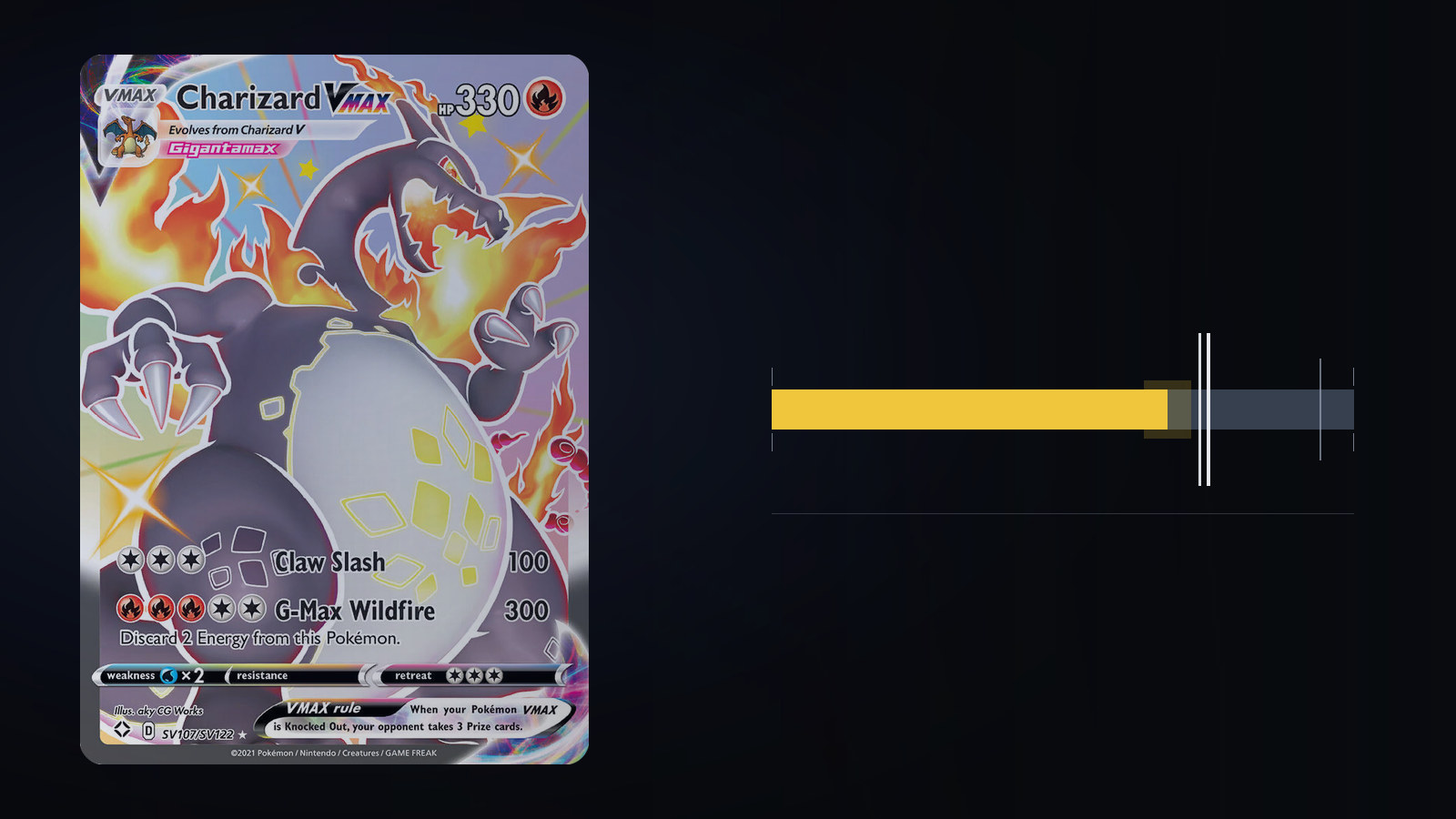
September 16, 2026, Charizard VMAX SV107, $191.99 and 100 days.
That total is a PSA 9 at its live market price plus the cheapest tier PSA is selling this morning, and the 100 days is PSA's own estimate rather than a guess of mine. Cracking a PSA 9 Charizard VMAX SV107 still loses money at PSA's new $59.99 tier, because the trailing gem rate of 68% sits below every breakeven I can build from today's prices. The default answer in this column is hold, and today it is hold, though the fee change moved this card further than anything I have watched a fee do. It went from a trade nobody could win to a trade that misses by seven points.
What $59.99 and five months actually cost
PSA's pricing page, opened this morning, carries a tier called Standard at $59.99 a card. It insures a card to $1,000 and quotes 90 to 100 business days. That is close to five months between the post office and the return box, and the tier above it is the one this column has priced all year, now called Priority at $79.99 and 70 to 80 business days. Value submissions are still paused, so Standard is the cheapest door open to anybody, and $59.99 is the number every line below runs on.
The nine you would be cracking reads $132.00 on PriceCharting's live page. Twenty three PSA 9 copies sold between August 10 and September 14 on the completed auction tape that page keeps, once the BGS, CGC, TAG and SGC nines are dropped out of it. Their median is $124.00, so the headline runs about $8 ahead of what nines are actually clearing. That $8 matters here, because the distance between the two grades is narrow enough for it to move the answer, and postage both ways and insurance sit on top of the $191.99 where no price guide carries them.
What a ten returns once the marketplace has taken its cut
A PSA 10 reads $250.59 on our own board and $250.25 on the live page this morning. The realised tape backs it: 30 PSA 10 sales between September 7 and September 15, median $243.00, low $195.66, high $299.66. Sell that ten and 13% goes to the marketplace and the shipping, so a hit leaves $217.72 against an outlay of $191.99. A miss leaves $114.84, and the same cut on the $125.71 a raw copy fetches leaves $109.37, so the slab is worth about $6 more than the card inside it.
The whole distance between the two grades is $118.59, which is small money for a card people talk about this much, and a narrow gap is what makes a flat fee heavy. It is also what makes a miss cheap, so the two effects pull against each other instead of compounding. Cracking a nine here throws away that $6 of slab premium, where cracking a card with a wide gap throws away a great deal more. That is the honest argument for doing it, and I want it on the page before the arithmetic takes it away.
A PSA 9 Charizard VMAX SV107 needs 74.8%
Each line below pairs a nine price with a ten price from one source, because a nine off one site and a ten off another can describe two different products. Our own board, read today, pairs $132.00 with $250.59 and needs 74.8% at the $59.99 fee. PriceCharting's live page pairs the same nine with $250.25 and needs 75.0%. The realised tape pairs $124.00 with $243.00 and asks for 73.5%, and the most generous crossing of the two sources, the cheapest nine against the dearest ten, still asks 69.3%.
The trailing 30 day gem rate on this card is 68%, measured across the 492 grades it added in the month to September 14. Submissions fell 21% against the 620 grades of the month before. The card's own weekly grading record brackets that count: its last four weekly points add 468, and its last five add 584, so 492 sits where a 30 day window should put it. A rate of 68% off 492 grades carries a 95% band of 63.9% to 72.1%, and every breakeven above sits outside the top of that band. This is the rare week where the miss is wider than the measurement error, so I am not asking you to read a coin toss.
At the live PriceCharting pair the trade returns minus $7.19 a card. That is about 3.7% of what you put in, and lifetime on this card is 74.7%, because 36,529 of the 48,873 copies ever submitted came back tens. That is nearly seven points above the month that actually just happened. A Charizard ex 199 failed the same way two weeks ago, and our reading of the lifetime figure on that card is this trap in different numbers. Anyone quoting you 74.7% here is quoting five and a half years of submissions, most of them from a period when the card was being opened out of packs rather than bought out of binders.
Where the old fee left this, and what $20 bought
At the $79.99 tier our board puts breakeven at 94%, and no run of luck reaches a rate that high on a card grading in the sixties. Twenty dollars of fee took that figure down more than nineteen points, to 74.8%. That is the largest single improvement I have seen one price change make to a trade in this column. The fee does that much work because the gap it is measured against is only $118.59, so every dollar saved counts for nearly a point of required gem rate. Express, at $199 a card, asks 210%, which is a number that cannot exist.
Our board still prints the 94% figure rather than the cheaper one, and that is deliberate rather than stale. Standard caps declared value at $1,000, and a good share of the cards we line up have a PSA 10 worth more than that. A single cheap fee applied across the whole table would quietly price submissions nobody is allowed to make. The board where we line up every nine and ten price we track therefore runs on the tier that covers almost everything, and this card is one where you should do the cheaper sum yourself. The calculator that takes your own fee and your own selling cost carries the new tier as of today.
That 68% came off raw cards rather than off nines
Here is the part that decides it for me, and it is not in any of the arithmetic above. A population gem rate counts every copy of the card PSA has ever graded, and the overwhelming majority of those arrived raw. The card you are proposing to crack is not one of those. It is a card PSA has already looked at once and declined to call a ten, which makes a resubmission a different experiment from the one 68% describes.
Nobody publishes a gem rate for resubmitted nines, mine included, so I cannot hand you a number to use instead, but I can say which direction it runs, and it runs against the trade every time. Treat 68% as a ceiling on what cracking this card does rather than as an estimate of it, and the miss at seven points widens rather than closing. The page explaining how we build that breakeven figure says the same thing in one line, and this is the week it matters most.
The grade tail runs the same way, and it is small enough that I nearly left it out. Of the copies that miss the ten, 9,508 landed on a nine, but about 9% came back a seven or worse. Pricing that tail off the lifetime composition costs another $1.74 a card. A slab that already holds a nine is less likely to fall that far than a raw card is, so I would not lean on the figure, and I would not pretend the tail is zero either.
The one reading where this clears, by $1.22
Take the realised tape on both sides, $124.00 for the nine and $243.00 for the ten, and run it at the lifetime 74.7% rather than at the trailing 68%. That version returns plus $1.22 a card, and it is the only combination on this page that turns a profit. It needs the optimistic price pair and the optimistic rate at the same time, and it pays a dollar and change for five months of waiting. I have published it because the column is supposed to show the reading that argues against the verdict.
The queue is the last thing, and it is the biggest. Those 30 PSA 10 sales all landed inside nine days and ranged $104 from low to high, so the ordinary week to week movement in the exit price is more than fourteen times the $7.19 the trade is short. You are being asked to hold the card through roughly five months of that to chase a margin smaller than a single bad Tuesday.
Our look at how much of one card's gap a flat fee swallows was the same shape a week ago, at a card where the fee took half. The difference this week is that the fee moved instead of the card, and it still was not enough. Do not mail this nine until the trailing rate clears 75%.